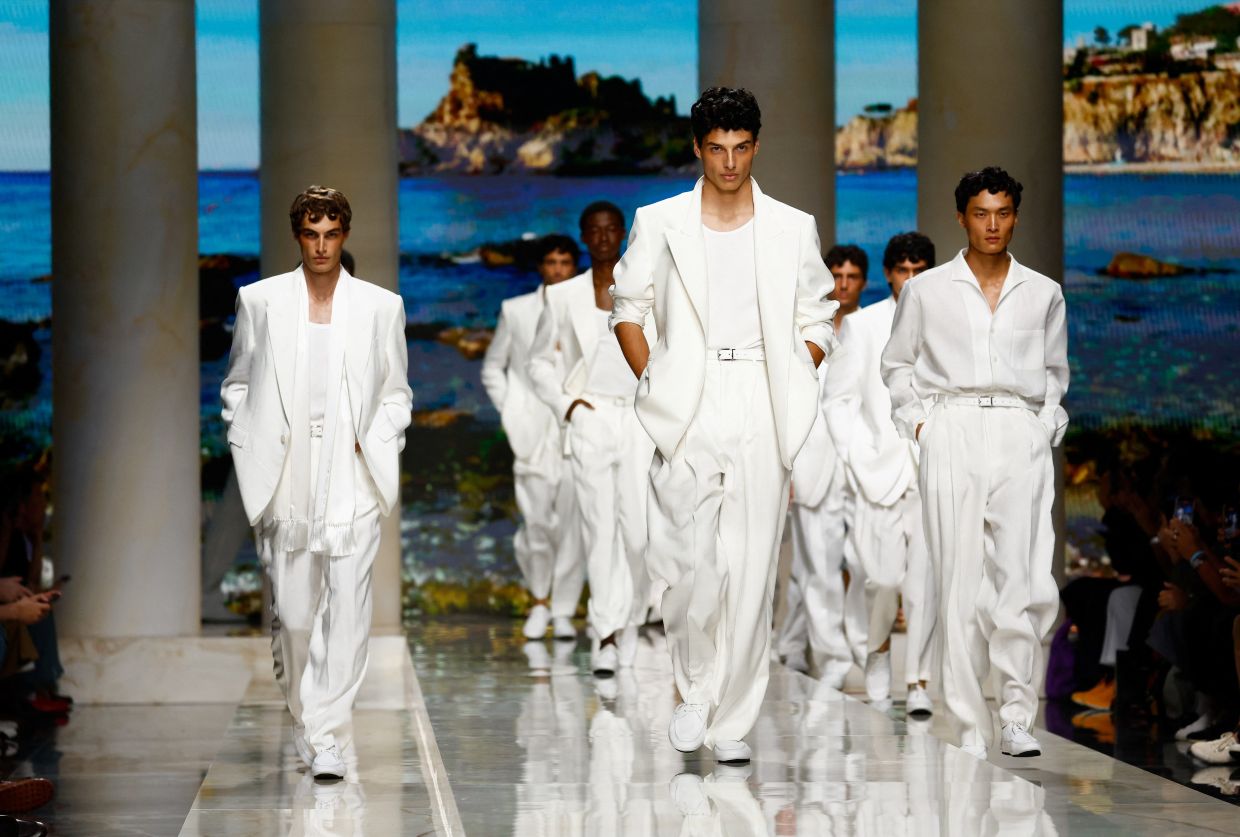
The conclusion of Milan Fashion Week on Monday, June 22 revealed a fashion industry grappling with conflicting impulses: the desire for restraint in economically uncertain and geopolitically tense times, balanced against the perennial human appetite for excess and spectacle. Across the runways, menswear designers largely gravitated toward a philosophy of reduction, stripping away unnecessary embellishment to present cleaner lines and more considered proportions. This aesthetic moderation, however, came not from an abundance of caution but from a deliberate creative strategy to find meaning in simplicity whilst simultaneously confronting the practical challenge of dressing bodies for a sweltering Milanese summer.
Prada set the tone for the season under the artistic direction of co-creative leads Miuccia Prada and Raf Simons, who championed a vision rooted in the reimagining of familiar garments through unexpected proportions and innovative material treatments. Their approach suggested that luxury lies not in novelty or ornament, but in the refinement of basics — a philosophy that resonated throughout much of the Milan calendar. This advocacy for simplicity shaped how other houses approached their collections, establishing a conceptual framework that prioritised the relationship between fabric, form and the body itself.
The persistence of leather across multiple collections proved the most striking thematic consistency of the season, even as it appeared counterintuitive for summer dressing. Prada's leather offerings drew conceptual inspiration from denim's universality, resulting in slim five-pocket trousers paired with cropped jackets that functioned as hybrid garments. Beyond Prada, other designers employed technical innovations including woven and perforated construction methods to render leather breathable and wearable in elevated temperatures. This approach epitomised the broader tension between fashion's luxury traditions and the practical demands of contemporary climate conditions — a challenge that increasingly defines menswear design.
After years of volumetric oversizing that dominated fashion discourse, the Milan collections signalled a decisive return to silhouettes that acknowledge and celebrate the masculine form. This resurgence of body-conscious tailoring represented a philosophical shift from the deliberate shapelessness of recent seasons. The suit emerged as a persistent symbol of formality and civilisation, yet designers reconceived it for contemporary contexts through lightened construction, opened necklines and experimental layering. Dolce & Gabbana took this exploration to its most provocative extreme with microshorts that exposed the leg, while other houses selectively bared the torso, suggesting that tailored elegance no longer demands complete coverage.
Ventilation became an explicit design principle rather than an accidental consequence. Designers left dress shirts unbuttoned as standard practice, with some rendered in transparent fabrics that maintained visual formality whilst offering practical relief. Other collections dispensed with the shirt entirely, relying instead on the jacket as primary garment. Long trousers remained the silhouette of choice across most houses, though this consistency masked significant evolution in construction and fabric weight. The result was a new taxonomy of summer tailoring — formal yet breathable, refined yet practical, maintaining menswear's traditional codes whilst adapting them for climatic and social realities.
US designer Thom Browne, operating under Zegna ownership, returned to Milan for the first time since 2008 with collections that drew extensively on seersucker and pleated construction — fabrics and techniques traditionally associated with summer wardrobes. His layered suiting suggested that complexity and formality need not conflict with seasonal appropriateness, opening alternative interpretive pathways for how tailoring might evolve. The presentation reinforced an emerging consensus: the suit remains foundational to menswear identity, but its future depends on continuous technological and aesthetic innovation to remain relevant across changing environmental and social contexts.
Yet this embrace of restraint represented only one pole of Milan's creative spectrum. Philipp Plein presented crystal-encrusted denim requiring days of artisanal handwork, whilst Dolce & Gabbana leaned deliberately into maximalist embellishment with beaded detailing that referenced coral ecosystems. These contrasting visions — Prada's reductive philosophy against Plein's and Dolce & Gabbana's maximalism — demonstrated that fashion's current moment accommodates divergent responses to uncertainty. Some designers believe restraint communicates wisdom and cultural sensitivity; others argue that glamour and spectacle remain valid expressions of creativity and aspiration, particularly as economic pressures intensify consumer desire for escapism.
A lighter overall calendar created unexpected opportunities for emerging design voices to gain meaningful visibility alongside established heritage houses. Martin Quad made his Milan debut with unusual tailoring conceits that had previously garnered attention within Copenhagen's design circles, suggesting that geographic diversification of the menswear calendar may benefit designers outside traditional fashion capitals. Similarly, Domenico Orefice presented a co-ed collection exploring leather and richly textured woven materials, whilst Japanese designer Shinya Kozuka introduced his Shinyakozuka label with collections that prioritised poetic sensibility over commercial calculation.
Kozuka's aesthetic exemplified the season's lyrical potential, particularly in a presentation featuring a shirtless model wearing a billowing sheer coat in teal paired with relaxed white trousers — an image that captured something essential about the season's ambition. This silhouette synthesised multiple threads running through Milan: the acceptance of exposure, the embrace of transparency both literal and metaphorical, the confidence that beauty emerges from proportion rather than coverage. The collection suggested that Summer 2027 menswear need not choose between formality and freedom, between luxury traditions and contemporary casualness.
What emerged from Milan Fashion Week was not a singular direction but rather permission for multiplicity. Designers demonstrated that simplicity and maximalism, restraint and glamour, traditional tailoring and experimental silhouettes could coexist within a single season's offerings. This pluralistic approach may reflect broader cultural uncertainty — an inability to articulate definitive answers to economic and geopolitical questions — or it may represent maturity, the recognition that fashion serves diverse consumers with divergent values and aspirations. For Southeast Asian fashion followers and industry professionals, the Milan collections signalled that luxury menswear's future remains committed to tailoring excellence and material innovation, whilst remaining increasingly responsive to practical concerns including climate, cost and sustainability.