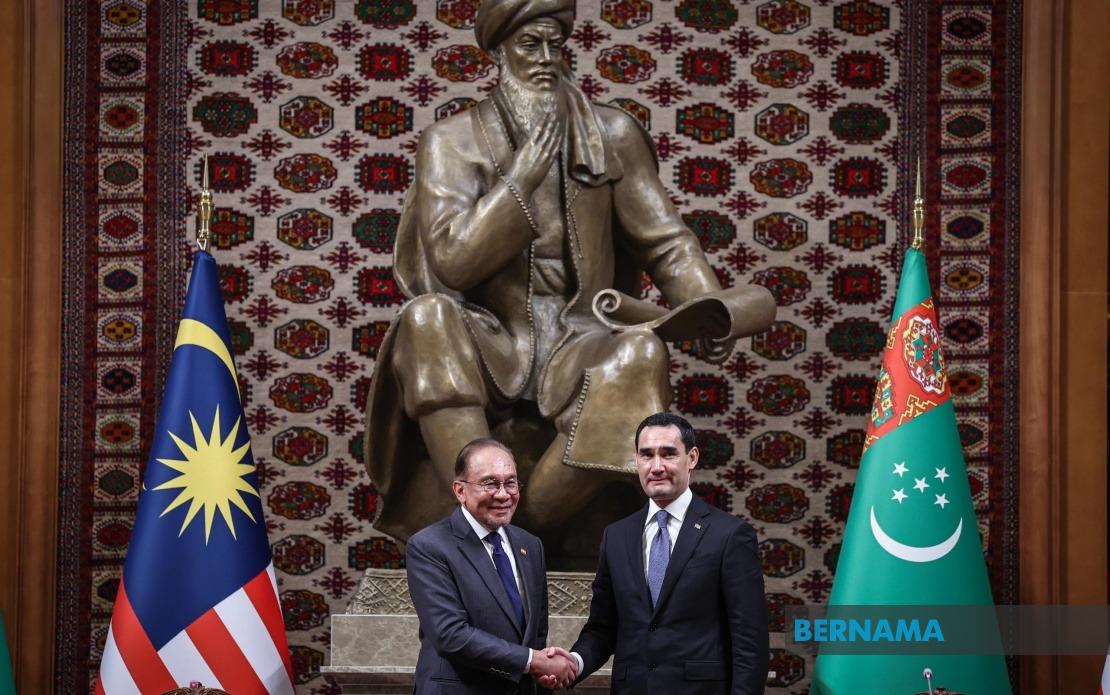
Prime Minister Datuk Seri Anwar Ibrahim has announced a significant deepening of Malaysia's relationship with Turkmenistan, characterising the partnership as one built on strategic interests and tangible benefits for both populations. Speaking from Ashgabat on Friday following his meeting with Turkmenistan President Serdar Berdimuhamedov at the Presidential Palace, Anwar underscored the two nations' determination to move beyond symbolic gestures toward concrete, measurable cooperation. The bilateral engagement represents a deliberate shift toward what both leaders describe as a structured, progressive and mutually complementary framework that respects the sovereignty and development priorities of each country.
The substance of this commitment materialised through the formal exchange of multiple agreements and memoranda of understanding. Four key documents were signed during the official ceremony, reflecting the breadth of intended collaboration. These included an Air Services Agreement that will facilitate enhanced aviation connectivity between the two nations—a practical measure that directly benefits business travellers, investors, and citizens seeking to strengthen people-to-people ties. The agreements extend beyond transport infrastructure into the diplomatic apparatus, with Malaysia's Institute of Diplomacy and Foreign Relations formalising cooperation with Turkmenistan's Institute of International Relations, establishing structured channels for ongoing policy dialogue and knowledge exchange.
The institutional framework encompasses both transportation and scientific dimensions. Malaysia's Ministry of Transport signed a separate memorandum with Turkmenistan's State Service, positioning the nations to collaborate on logistics, infrastructure standards, and mobility solutions relevant to their respective development trajectories. Equally significant is the partnership between the Academy of Sciences Malaysia and its Turkmenistan counterpart, signalling commitment to research collaboration that could yield innovations in fields ranging from energy efficiency to agricultural technology—sectors where both nations hold strategic interests.
The breadth of sectoral engagement outlined by Anwar reveals the ambitions embedded within this partnership. Energy cooperation stands foremost given Turkmenistan's substantial hydrocarbon resources and Malaysia's experience as a developed energy economy with sophisticated downstream industries and expertise in liquefied natural gas. Trade and investment discussions suggest Malaysian businesses may access new market opportunities whilst Turkmenistan gains exposure to Malaysian investors with regional expertise. The halal industry represents a distinctive avenue where Malaysia's established credentials—encompassing certification, logistics, and consumer trust—position the nation as a natural partner for a predominantly Muslim nation seeking to develop this growing global market segment.
Islamic banking and finance constitute another pillar with profound implications for both economies. Malaysia has cultivated world-leading expertise in Islamic financial instruments, sukuk issuance, and Shariah-compliant investment structures. Turkmenistan, developing its own financial sector sophistication, stands to benefit from technical cooperation and capacity building in this arena. The education dimension extends this knowledge transfer across multiple disciplines, with opportunities for student exchanges, academic partnerships, and institutional twinning arrangements that build human capital and foster mutual understanding across generations.
The inclusion of science and technology cooperation reflects contemporary development imperatives. Both nations recognise that technological advancement and research capability increasingly determine economic competitiveness and quality of life. Joint research initiatives, shared laboratories, and collaborative problem-solving in areas such as sustainable energy or water resource management could yield benefits exceeding what either nation might achieve independently. Tourism collaboration opens doors to cultural exchange and economic diversification, particularly as both nations seek to develop this sector as a source of foreign exchange and employment.
Anwar's emphasis on disciplined, transparent and effective implementation represents a crucial distinction from aspirational frameworks that languish unfulfilled. The commitment signals that both governments recognise the gap between signing documents and realising their potential, and have agreed to establish monitoring mechanisms and accountability structures. This practical orientation reflects Anwar's broader economic governance philosophy, prioritising execution and measurable outcomes over ceremonial announcements.
The visit itself carries symbolic weight as Anwar's first official journey to Turkmenistan since assuming office as Malaysia's 10th Prime Minister in November 2022. The eighteen-month interval suggests careful diplomatic sequencing and preparation to maximise the visit's impact. The delegation composition—including Minister of Investment, Trade and Industry Datuk Seri Johari Abdul Ghani and Minister of Economy Akmal Nasrullah Mohd Nasir—reinforces that this engagement prioritises economic substance. Their presence signals to Malaysian business communities that government is actively cultivating market access and investment opportunities beyond traditional Southeast Asian markets.
From a geopolitical perspective, Malaysia's strengthening ties with Turkmenistan serve multiple strategic interests. The Central Asian nation occupies a pivotal position along historic trade corridors connecting Europe, the Middle East, and Asia, making it relevant to Malaysia's Belt and Road participation and broader ambitions to participate in transcontinental commerce. Turkmenistan's energy resources contribute to regional stability and diversified supply chains, concerns increasingly salient as global energy markets experience volatility. The partnership also reflects Malaysia's deliberate cultivation of relationships across Islamic-majority nations, reinforcing soft power and the nation's positioning as a bridge between the Muslim world and global commerce.
Turkenistan's acceptance of Malaysia's partnership overtures similarly reflects strategic calculations. Malaysia offers proven expertise in economic diversification, financial sector development, and integration into global value chains—lessons particularly relevant as Central Asian nations seek alternatives to overdependence on particular trading partners. The halal and Islamic finance expertise represents genuine comparative advantage that Malaysian institutions have invested decades developing. For Turkmenistan, accessing this knowledge base accelerates its own development trajectory without requiring parallel domestic investment in building these capabilities from inception.
The joint statement issued following the bilateral meeting institutionalises these commitments at the highest level, signalling that the partnership commands presidential-level attention and will not be relegated to lower bureaucratic levels where implementation often falters. The personal engagement of Anwar and Berdimuhamedov suggests both leaders view this relationship as consonant with their respective national visions and worth dedicating finite political capital to advance.
Looking forward, the true measure of this partnership will emerge over the subsequent months and years as these agreements transition from formal parchment to lived reality. Malaysian companies must find genuine commercial opportunity in Turkmenistan; students must actually enrol in exchange programmes; research teams must collaborate across borders on concrete projects. The establishment of institutional frameworks creates necessary conditions for deepening ties, but sufficient conditions require consistent follow-through. For Malaysian observers and policymakers, this engagement demonstrates that diversification of international partnerships beyond the immediate region remains an explicit strategic priority, opening economic and diplomatic possibilities that complement rather than compete with existing Southeast Asian commitments.