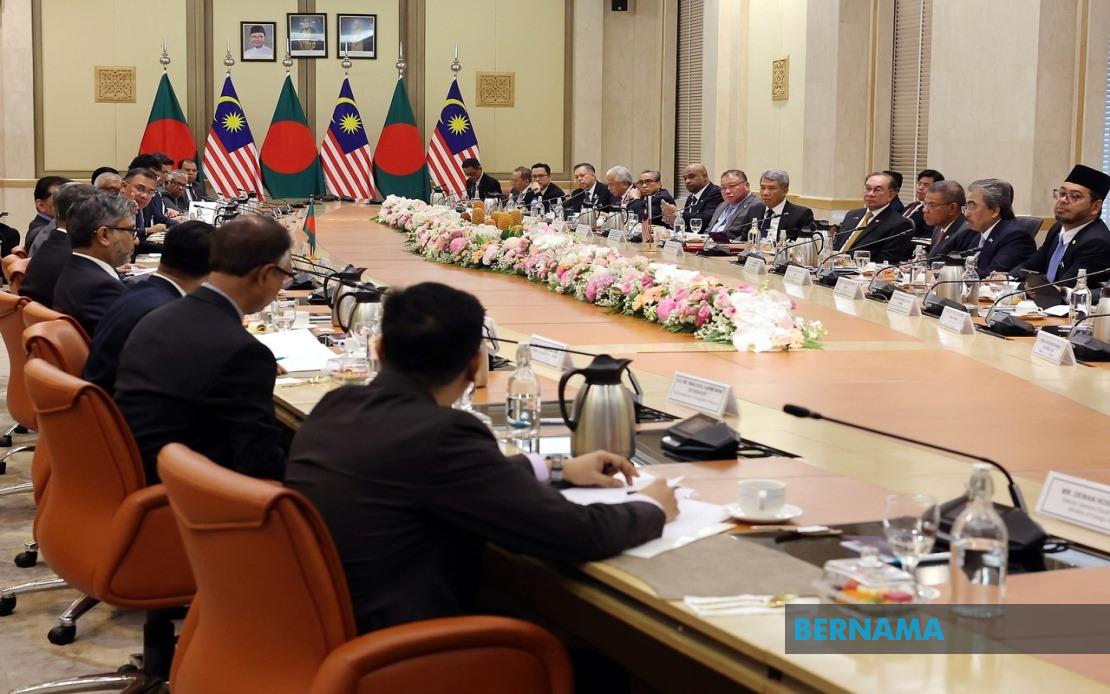
Prime Minister Datuk Seri Anwar Ibrahim has called for Malaysia and Bangladesh to deepen their partnership by venturing into cutting-edge technological sectors, signalling a strategic shift away from conventional trade relationships. Speaking alongside visiting Bangladesh Prime Minister Tarique Rahman at a joint press conference in Putrajaya on June 22, Anwar outlined an ambitious agenda that positions both nations to capitalise on the digital transformation reshaping the Asian economy. The two leaders, who witnessed the signing of multiple cooperation agreements, recognised that sustaining regional competitiveness requires moving beyond legacy sectors into domains that will define economic relevance in the coming decades.
The scope of proposed collaboration reflects growing recognition among Southeast Asian governments that artificial intelligence, semiconductor fabrication, and energy transition represent existential business opportunities. Anwar specifically highlighted the necessity for Malaysia and Bangladesh to jointly explore advanced manufacturing capabilities, digital economy frameworks, and renewable energy development alongside their existing agricultural partnerships. This diversification strategy acknowledges that while farming has historically anchored bilateral trade, modern economies require technological depth to generate high-value employment and attract multinational investment. The emphasis on AI is particularly instructive: both nations face the dual challenge of harnessing AI's productivity benefits while managing workforce displacement risks common to labour-intensive industries prevalent in South and Southeast Asia.
The bilateral relationship carries tangible significance for Malaysia's broader regional positioning. Bangladesh, with a population exceeding 170 million and rapid industrialisation, represents a substantial market and production partner. Enhanced cooperation in semiconductors could create complementary supply chain opportunities, especially as global manufacturers seek alternatives to concentration in Taiwan and East Asia. Malaysia's existing semiconductor expertise and manufacturing infrastructure position it as a logical knowledge partner, while Bangladesh's lower labour costs and growing technical workforce make it an attractive production base. This complementarity suggests that bilateral cooperation could yield mutual benefits rather than competitive friction.
Energy collaboration addresses an equally pressing concern for both economies. Bangladesh faces acute electricity shortages as industrialisation accelerates, while Malaysia possesses renewable energy ambitions and hydrocarbon resources. Joint projects in liquefied natural gas, solar technology, or grid modernisation could address supply constraints while creating financing opportunities for Malaysian companies expanding regionally. For Bangladesh, energy security directly impacts its manufacturing sector's international competitiveness—unreliable power supplies deter foreign investors. Malaysian involvement could signal confidence in Bangladesh's infrastructure trajectory, potentially unlocking additional international investment.
The signing of a Memorandum of Understanding on Cultural Cooperation alongside counter-terrorism research agreements indicates that both governments view the relationship through a comprehensive security and people-to-people lens. Counter-terrorism collaboration reflects shared vulnerabilities in an era of transnational security threats, while cultural cooperation acknowledges the substantial Bengali-origin communities in Malaysia and growing educational exchanges. These agreements create institutional frameworks for sustained engagement beyond economic transactions, building resilience into the bilateral relationship.
The Investment Promotion and Facilitation agreement carries particular weight in Southeast Asia's competitive race for capital. By formalising investment protections and dispute mechanisms, Malaysia and Bangladesh signal to their respective business communities that cross-border ventures carry reduced regulatory uncertainty. This formality matters: Malaysian companies considering manufacturing expansion into Bangladesh can access clearer legal frameworks, while Bangladeshi investors seeking Malaysian technology partnerships gain security against arbitrary policy changes. In the context of rising geopolitical tensions and shifting global supply chains, such bilateral certainty has become a valuable commodity.
However, translating these ambitions into concrete projects requires navigating substantial practical challenges. Bangladesh's infrastructure development remains uneven, particularly outside major cities, potentially complicating large-scale semiconductor or advanced manufacturing initiatives. Similarly, cybersecurity frameworks essential for AI collaboration demand institutional capacity that both nations continue building. Financing mechanisms must also align—joint infrastructure projects typically require long-term, patient capital that development banks and sovereign wealth funds provide, necessitating coordination beyond bilateral government channels.
For Malaysian policymakers, deepening engagement with Bangladesh reflects rational hedging against economic concentration risk. Overreliance on Chinese trade relationships or heavily integrated regional supply chains through Asean exposes Malaysia to geopolitical volatility. Bangladesh offers geographic diversification and demographic complementarity: its massive working-age population provides labour-intensive manufacturing capacity, while Malaysia's capital and technology resources address Bangladesh's development needs. This relationship architecture differs from Malaysia's traditional partnerships with developed economies, instead positioning Anwar's government as a development partner and technology exporter to a substantial emerging market.
The timing of this bilateral push carries significance within Malaysia's broader foreign policy trajectory. Under Anwar's administration, Malaysia has emphasised South-South cooperation and South Asian engagement as counterweights to established alignments. Bangladesh, as the primary economic engine of South Asia after India, logically deserves elevated diplomatic attention. Enhanced cooperation with Dhaka could position Malaysia as a bridge between South Asian growth dynamics and Southeast Asian manufacturing ecosystems, a role with considerable strategic value as regional economies rebalance against global slowdowns.
Looking forward, success will depend on translating rhetorical commitments into operational reality. Bilateral trade structures, regulatory harmonisation, human capital development, and long-term financing mechanisms all require sustained attention beyond high-level visits. The agreements signed during Tarique Rahman's visit establish foundational commitments, but implementation capacity—particularly Bangladesh's institutional readiness for complex technology partnerships—will determine whether cooperation achieves its transformative potential. Nevertheless, the stated intention to expand beyond conventional sectors represents the kind of forward-thinking bilateral engagement that emerging economies require to navigate technological disruption and capture disproportionate shares of regional growth.