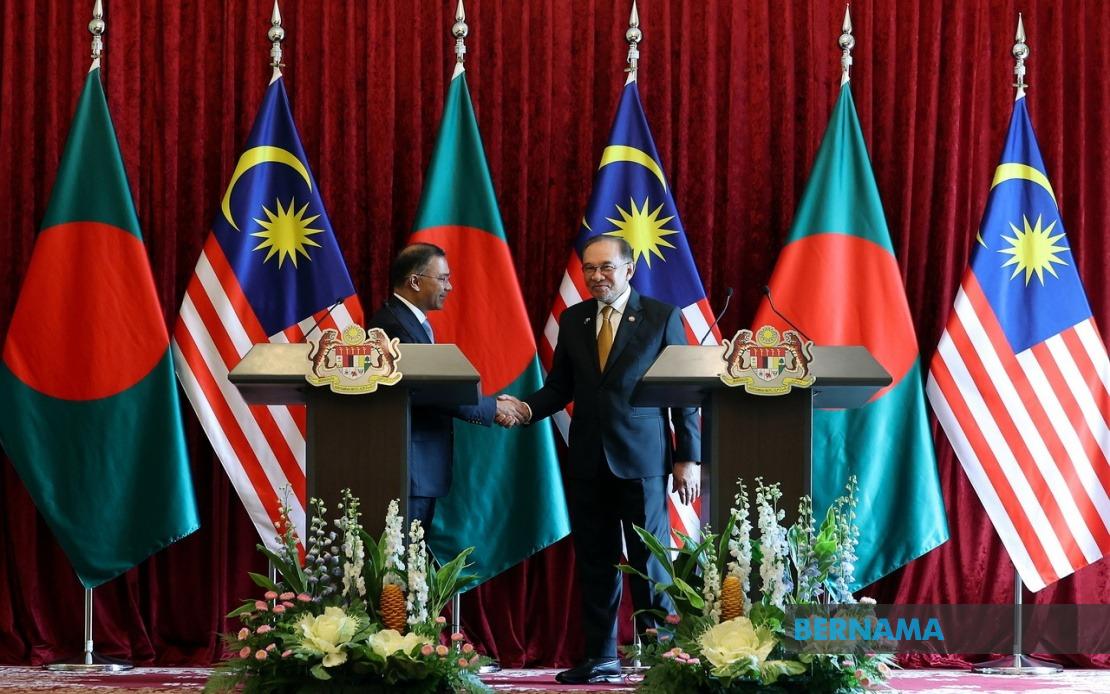
Prime Minister Datuk Seri Anwar Ibrahim and visiting Bangladesh Prime Minister Tarique Rahman have signalled a significant deepening of bilateral defence ties, committing to activate a previously signed Memorandum of Understanding on Defence Cooperation that will create structured pathways for military collaboration across multiple domains. The announcement, made during Tarique Rahman's official visit to Malaysia, reflects both nations' recognition of shared security challenges and mutual strategic interests in an increasingly complex regional environment.
The defence partnership outlined in the joint statement encompasses several interconnected pillars that extend well beyond traditional military-to-military engagement. Military science collaboration, technical expertise sharing, and joint ventures in the defence industry form the substantive core of the initiative, positioning the two countries to benefit from complementary capabilities and industrial strengths. This approach mirrors regional trends where nations increasingly view defence partnerships not merely as security arrangements but as economic and technological advancement vehicles.
A crucial institutional mechanism underpinning this expanded cooperation is the bilateral Joint Committee on Defence Cooperation, which both leaders committed to convening in order to establish a detailed roadmap for implementation. This structured framework signals that the two governments intend to move beyond rhetorical commitments to concrete, measurable outcomes with defined timelines and accountability mechanisms. The JCDC's establishment will likely address operational details including resource allocation, personnel secondments, and project milestones.
Personnel development and knowledge transfer constitute pivotal elements of the deepened partnership. Both nations have committed to enhancing defence capacity through tailored training programmes, with particular emphasis on mutual seat allocations at their respective National Defence Colleges and Command and Staff Colleges. This mutual commitment to officer-level education represents an investment in long-term interoperability and shared strategic perspectives, as senior military leaders educated in each other's institutions tend to develop deeper professional relationships and mutual understanding of operational doctrines.
United Nations peacekeeping operations have emerged as a significant area for joint endeavour. Malaysia and Bangladesh both contribute to global peacekeeping efforts across multiple theaters, and the commitment to conduct joint tactical exercises and pre-deployment training collaboration positions them to enhance operational effectiveness while reducing duplication of effort. The emphasis on exchanging expertise and knowledge reflects recognition that modern peacekeeping demands increasingly sophisticated capabilities in civil-military coordination, crowd control, and protection of civilians in complex conflict environments.
Counter-terrorism and violent extremism prevention form another substantial pillar of the partnership, acknowledging regional concerns about transnational militant networks and radicalisation pathways. The commitment to intelligence sharing, information exchange, capacity-building initiatives, and best practice dissemination addresses a security domain where both nations face genuine shared vulnerabilities. Bangladesh's experiences combating terrorism in its own context offer valuable lessons for Malaysian security practitioners, while Malaysia's counter-extremism programmes and deradicalisation initiatives similarly provide models worthy of study and adaptation.
Beyond the strictly military dimension, the partnership encompasses substantive educational collaboration that carries significant socio-economic implications for both nations. The recognition of approximately 11,000 Bangladeshi students currently studying in Malaysia underscores the existing human dimension of the bilateral relationship. Rather than viewing these students merely as individuals pursuing education, both governments now position them as living bridges between societies, potential agents of future cooperation, and investments in long-term soft power.
The commitment to expand university-to-university partnerships and joint research programmes, with particular focus on technical and vocational education, reflects both nations' recognition that competitive advantage increasingly derives from shared knowledge creation rather than zero-sum competition. By aligning academic programmes with labour market needs and priority sectors in both countries, the initiative seeks to produce graduates whose skills directly address regional development priorities. The emphasis on graduate mobility signals intent to facilitate career pathways that benefit professionals from both nations, creating networks of individuals with cross-border professional experience.
Tourism cooperation represents the softer dimension of bilateral engagement, with both leaders expressing optimism about leveraging Malaysia's 'Visit Malaysia 2026' campaign and 'Malaysia Year of Medical Tourism 2026' initiatives to attract Bangladeshi travellers. Medical tourism particularly carries significance for Bangladesh, where substantial middle and upper-class populations seek higher-quality healthcare services, and Malaysian facilities have become increasingly competitive in this space. Enhanced tourism promotion and cultural exchanges create economic opportunities while building popular support for deeper governmental cooperation.
The timing of this enhanced cooperation framework reflects broader regional dynamics where Southeast Asian nations increasingly recognize that bilateral relationships require active cultivation rather than passive reliance on historical ties. Malaysia's position as chair or influential voice in regional organisations, combined with Bangladesh's status as the world's eighth most populous nation and a growing economic power, creates complementarities that extend beyond defence to encompass trade, investment, and development cooperation.
For Malaysian policymakers and defence strategists, the Bangladesh partnership offers practical benefits in addressing transnational security challenges while providing access to training facilities and expertise that enhance overall defence capacity. Conversely, Bangladesh gains from engagement with a more technologically advanced defence sector and access to Malaysian institutions renowned for officer development. The partnership thus reflects contemporary international relations dynamics where even nations of vastly different development levels and military capabilities recognise mutual value in structured cooperation.
The emphasis on operationalising existing agreements rather than merely signing new ones suggests both governments have learned from previous initiatives that remained largely symbolic. By establishing the JCDC with explicit mandates and timelines, Malaysia and Bangladesh signal serious intent to transform rhetorical commitments into sustained practical collaboration. This pragmatic approach will likely set the tone for implementation across education, counter-terrorism, and tourism dimensions as well.