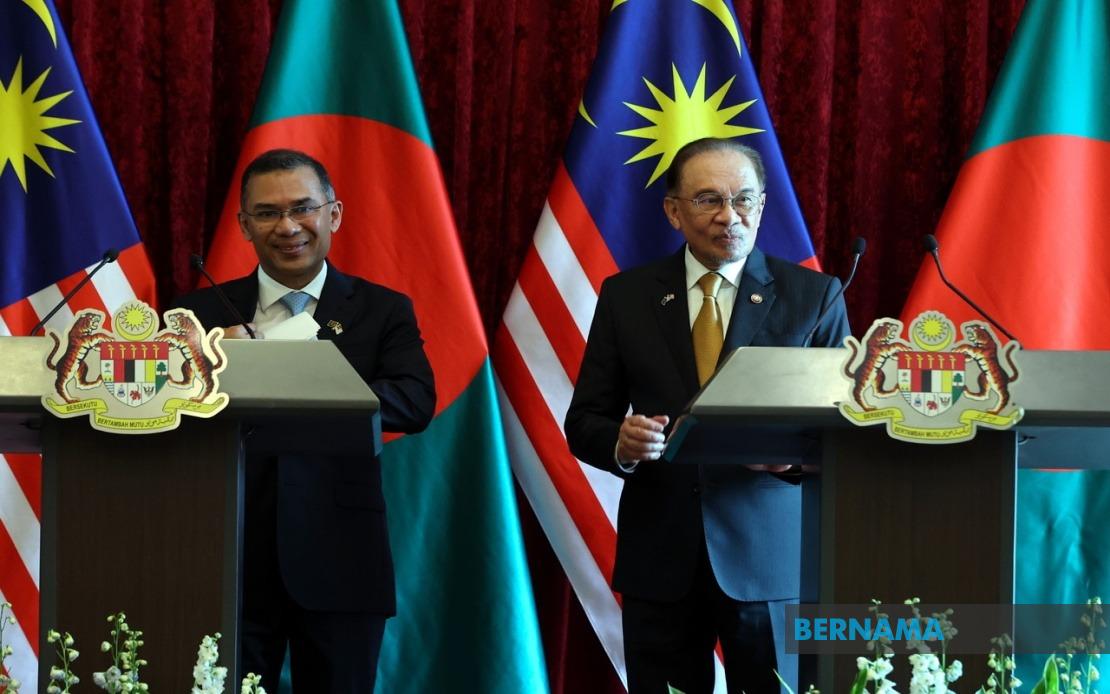
Malaysia and Bangladesh have reaffirmed their convergence on several pressing international questions, with Prime Minister Datuk Seri Anwar Ibrahim underscoring the two countries' shared commitment to peace-building efforts in volatile regions. The alignment encompasses support for the Palestinian cause, concern over the humanitarian situation in Gaza, and efforts to stabilise relations across the Gulf and with Iran, reflecting a broader partnership between the two Muslim-majority democracies in shaping regional and global affairs.
Anwar made these remarks during a joint press conference with Bangladesh Prime Minister Tarique Rahman, who is currently in Putrajaya on an official state visit that began on Sunday. The gathering underscored the depth of bilateral engagement at the highest political level, with both leaders emphasising the importance of sustained dialogue and coordination on matters affecting their populations and the wider Islamic world. The presence of Rahman in Malaysia marks a symbolic renewal of ties between two nations separated by geography but bound by historical, cultural, and ideological threads.
The joint statement on Palestine and Gaza reflects both nations' historical advocacy for Palestinian self-determination and their condemnation of what they characterise as Israeli military operations against civilian populations. Malaysia has long positioned itself as a vocal supporter of the Palestinian struggle within international forums, while Bangladesh, too, has maintained consistent diplomatic positions defending Palestinian rights. This alignment suggests potential for coordinated positions within multilateral bodies such as the United Nations, where both countries can amplify their concerns and mobilise support from other developing nations.
The emphasis on Gulf stability and Iran indicates a shared understanding of the region's strategic importance and the risks posed by escalating tensions. Malaysia, as a major Southeast Asian maritime power with significant economic ties to Gulf states, has a vested interest in preventing conflict that could disrupt trade routes and energy supplies. Bangladesh, meanwhile, has important labour connections with Gulf nations, with millions of its citizens working in the region. Both countries thus have tangible reasons to promote de-escalation and dialogue rather than confrontation.
Anwar's statement that both nations would "continue to engage with all our partners to ensure there is peace" suggests a diplomatic strategy centred on dialogue and consensus-building rather than confrontation. This approach aligns with Malaysia's broader foreign policy orientation, which emphasises non-alignment and balanced relationships with global powers. By engaging multiple stakeholders, both countries aim to position themselves as constructive voices in international forums, capable of bridging divides and promoting practical solutions to intractable conflicts.
Rahman's visit is particularly significant as his first official international trip since assuming the Bangladesh premiership in February this year following his Awami League party's election victory. The choice to visit Malaysia first signals the importance both nations attach to their relationship and suggests plans for deeper cooperation going forward. Such early diplomatic engagement by a new premier typically indicates areas targeted for institutional strengthening and expanded collaboration.
Anwar's warm characterisation of the relationship as part of an "enlarged family" reflects the depth of people-to-people connections between Malaysia and Bangladesh, driven by historical ties, diaspora communities, and shared Islamic heritage. The metaphor of family bonds emphasises emotional and cultural dimensions of the relationship beyond formal state-to-state interactions, suggesting both leaders view engagement as rooted in genuine affinities rather than mere transactional interests. This framing helps domestic audiences in both countries understand the visit as an expression of broader civilisational kinship.
The bilateral relationship extends across multiple domains beyond foreign policy alignment. Economic cooperation, educational exchange, and cultural initiatives form the foundation upon which political coordination rests. By publicly highlighting their convergence on major international questions, both leaders are also signalling to their domestic constituencies that their governments are actively defending Islamic and developing-world interests on the global stage, a politically important message in both nations.
For Malaysia specifically, Rahman's visit reinforces the country's role as a convener in Southeast Asia and a bridge between the region and South Asia. As Malaysia works to strengthen its standing within ASEAN and enhance its broader international profile, partnerships with neighbouring South Asian powers become increasingly valuable. Bangladesh's growing economic and demographic significance—as the world's eighth most populous nation—makes it a natural partner for Malaysian initiatives aimed at deepening South Asian integration with Southeast Asia.
The timing of the visit also occurs amid evolving global geopolitical dynamics, where nations seek to consolidate relationships and clarify positions on contentious issues. Both Malaysia and Bangladesh have made clear their commitment to principles of multilateralism, non-alignment, and respect for international law, even as they take principled stands on matters affecting Muslim-majority regions and developing nations. Their joint messaging on Palestine, Gaza, and Iran suggests these issues will remain central to their foreign policy approaches.
Looking forward, the visit provides a platform for potentially expanding cooperation beyond political coordination. Areas of mutual benefit could include trade and investment, sharing of development expertise, collaborative approaches to climate change, and people-to-people exchanges. Both nations face similar developmental challenges and could benefit from sharing best practices and lessons learned in governance, economic growth, and social development.
The convergence articulated during this visit also carries implications for regional stability in Southeast Asia. A stronger Malaysia-Bangladesh relationship may encourage other ASEAN members to deepen engagement with South Asia, potentially creating new networks of cooperation and understanding that could help prevent regional tensions from escalating. By working together on international issues, both countries demonstrate that medium-sized powers can still exercise meaningful influence on the global stage when they coordinate effectively.