The MADANI government has recommitted itself to the Ziarah Kasih initiative, a welfare programme designed to deliver targeted assistance directly to citizens facing acute economic and health challenges. Speaking during an outreach event in Mersing, Abdullah Izhar Mohamed Yusof, political secretary to the Communications Minister, underscored the administration's determination to maintain regular implementation of the scheme as a cornerstone of its people-centred governance philosophy.
The programme operates through a systematic identification process managed jointly by the Department of Information and Komuniti MADANI, ensuring resources reach those most in need within Malaysian communities. By formalising these selection mechanisms, the government aims to reduce administrative inefficiencies and target assistance with greater precision toward vulnerable populations including the elderly, disabled individuals, and families facing severe financial distress. This structured approach represents a departure from ad-hoc charity models, embedding welfare support within formal institutional frameworks.
Ziarah Kasih embodies the Malaysia MADANI aspiration—a governance vision prioritising citizen well-being as a foundational principle rather than peripheral concern. The initiative's regular deployment signals the administration's recognition that poverty and health crises persist across Malaysian society despite broader economic growth, and that government must actively engage vulnerable populations through direct, tangible support mechanisms. This philosophy aligns with contemporary social policy trends across Southeast Asia, where governments increasingly combine targeted cash transfers with in-kind assistance to maximise welfare outcomes.
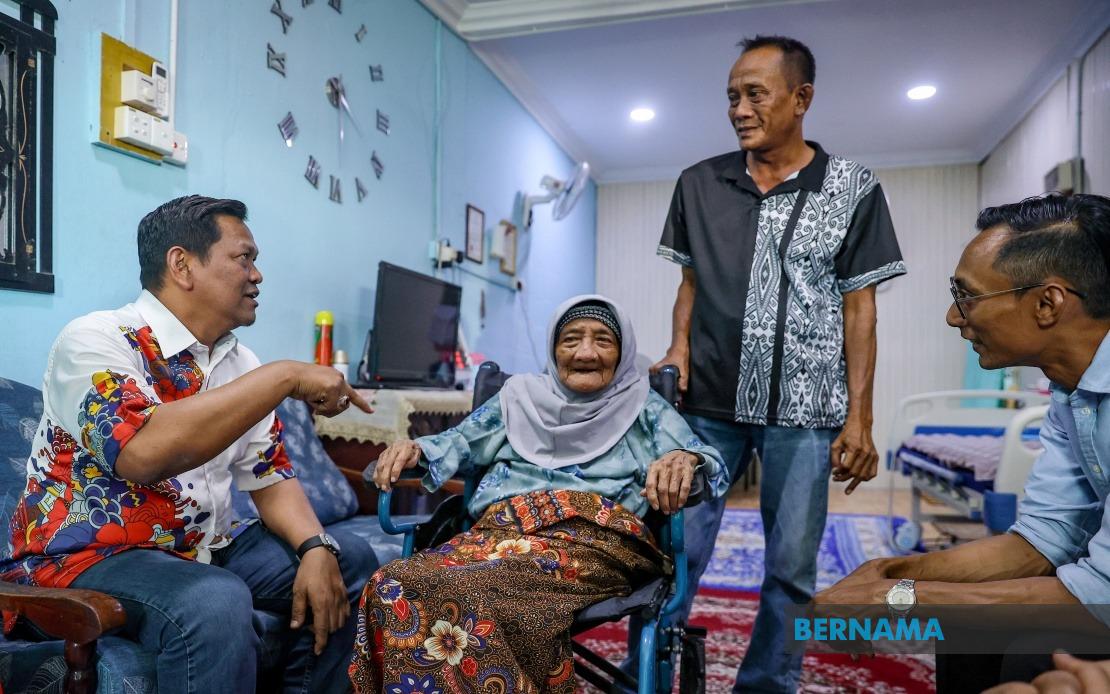
During the Jiwa@Komuniti MADANI Sembang Santai World Cup Edition programme in Endau, Abdullah Izhar personally visited beneficiary households, distributing financial contributions and healthcare equipment. These visible engagement moments serve dual purposes: delivering concrete assistance while simultaneously demonstrating governmental responsiveness to constituent hardship. Such direct ministerial contact with vulnerable populations carries symbolic weight in Malaysian political culture, signalling that senior officials remain connected to ordinary citizens' lived experiences.
One beneficiary, Hamdan Abd Latif, a 71-year-old bedridden resident, and his wife Meriam Abd Wahab, 66, exemplify the programme's target demographic. Hamdan's trajectory illustrates how health crises reshape family circumstances: a fishing accident in 2011, shortly before his scheduled retirement, revealed a previously undiagnosed brain tumour requiring surgical intervention. Though declared tumour-free post-operatively, subsequent complications including a stroke following a bathroom fall last year left him permanently bedridden. The financial and emotional toll redistributed across the household as Meriam transitioned from income-generating activities—supplementary sewing work—to full-time caregiving responsibilities.
Meriam's situation reflects broader patterns affecting Malaysian caregiving families, particularly spouses approaching retirement age who sacrifice economic independence to provide essential care for chronically ill partners. Her commentary regarding foregone sewing income highlights how health crises trigger cascading economic consequences extending beyond direct medical costs. Government assistance programmes like Ziarah Kasih attempt to arrest this economic deterioration by providing material support and medical equipment, reducing the financial burden families absorb when healthcare systems and pension schemes prove inadequate.
Another programme recipient, 91-year-old Zainon Ibrahim, illustrates multi-generational caregiving dynamics increasingly visible throughout Malaysia's ageing society. Her son Jamaluddin Ismail, aged 64 and formerly employed as a supervisor, abandoned his career approximately two years ago to provide full-time care. Rather than institutionalising his mother, Jamaluddin coordinated with siblings to distribute caregiving responsibilities across the extended family network. This arrangement reflects cultural preferences within Malaysian society favouring family-based elder care, yet imposes profound economic costs on individual family members whose employment prospects diminish as caregiving demands intensify.
Jamaluddin's gratitude toward government assistance demonstrates programme acceptance among beneficiaries who recognise limited alternative support mechanisms. He acknowledged that while Ziarah Kasih contributions cannot fully substitute foregone employment income or replace professional healthcare services, they materially alleviate daily living pressures. This modest framing—assistance helping "meet some of my mother's daily needs" rather than comprehensive welfare provision—reflects realistic expectations within Malaysian households experiencing chronic poverty or disability-related expenses.
The programme's expansion carries particular relevance for Malaysia's demographic trajectory. As the population ages and chronic disease prevalence increases, demand for elder care and disability support will intensify across all income strata. Ziarah Kasih's systematic approach to identifying and assisting vulnerable populations may serve as foundational infrastructure for more comprehensive social protection systems addressing Malaysia's changing needs. Southeast Asian governments facing similar demographic pressures increasingly recognise that sporadic charity cannot substitute for institutionalised welfare mechanisms with sustained funding and professional administration.
Implementation challenges remain. Ensuring equitable geographic distribution of assistance across urban and rural areas, preventing elite capture or political patronage from distorting beneficiary selection, and securing sustained funding amid competing budget pressures all present operational hurdles. The Department of Information and Komuniti MADANI's role proves critical in maintaining programme integrity and preventing politicisation of welfare decisions. Malaysian examples of welfare programmes corrupted through partisan allocation suggest that institutional safeguards warrant careful attention as Ziarah Kasih scales.
Beyond immediate poverty alleviation, the programme signals evolving social policy philosophy within Malaysian governance. Rather than viewing welfare exclusively through residual lenses—addressing only most extreme deprivation—the MADANI administration appears positioning targeted assistance as routine government function supporting broad population segments experiencing temporary or chronic hardship. This represents normative shift toward recognising healthcare crises, disability, and age-related dependency as shared social risks requiring collective institutional response rather than purely individual or family responsibility.
Looking forward, Ziarah Kasih's success depends on sustained political will, adequate resource allocation, and transparent beneficiary selection mechanisms. Its expansion could catalyse broader social protection reforms addressing Malaysia's incomplete welfare architecture. Regional observers monitoring Malaysian social policy development will assess whether this commitment translates into durable institutional change or remains episodic political gesture toward vulnerable populations.