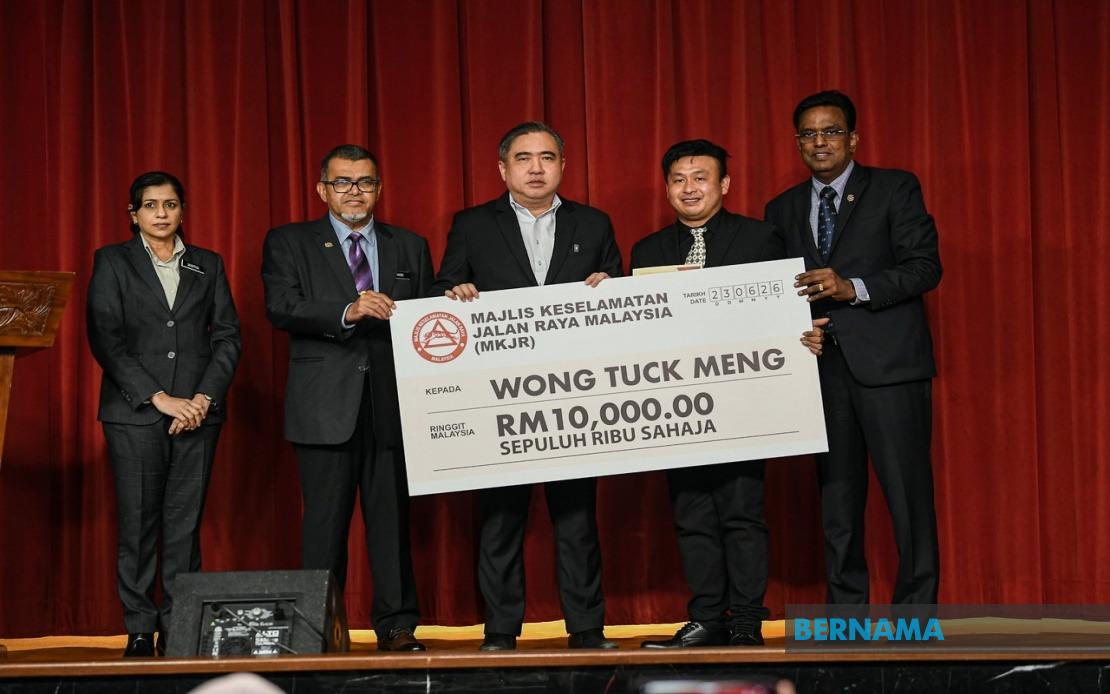
Wong Tak Ming, a lorry driver whose decisive actions last month prevented what could have been a catastrophic accident on a busy highway in Perak, received formal recognition from the Malaysian government on June 23 when Transport Minister Anthony Loke presented him with a Special Certificate of Appreciation and RM10,000 at a ceremony in Parliament. The award, funded by the Malaysian Road Safety Council (MKJR), acknowledged Wong's role in saving the lives of 21 passengers travelling on an express bus during an incident near the Menora Tunnel on June 15, underscoring the government's commitment to honouring ordinary citizens who demonstrate exceptional courage and responsibility on Malaysian roads.
The incident unfolded when an express coach operating the Kedah to Kuala Lumpur route encountered a technical malfunction while navigating a downhill section adjacent to the Menora Tunnel. As the bus lost control and veered dangerously across lanes, Wong's lorry positioned just ahead became the critical buffer that would determine whether the situation ended in tragedy or survival. Rather than attempting to accelerate away from danger, Wong maintained his composure and made the counterintuitive decision to allow the bus to collide with the rear of his vehicle, using his heavier vehicle as a decelerating force to gradually slow the runaway coach.
During his acceptance remarks, Wong demonstrated the same measured perspective that had guided his actions in the critical moments of the incident. He explained that his instinctive priority was not self-preservation but rather preventing fatalities and creating crucial seconds for other road users to clear the danger zone. With awareness that some distance still existed between his lorry and the approaching bus, Wong immediately activated his vehicle's horn system to alert drivers ahead to vacate the collision path, effectively extending the window of opportunity for people to move out of immediate peril. His deliberate choice to angle his vehicle closer to the guardrail whilst maintaining contact with the bus demonstrated both technical skill and tactical thinking under circumstances that would have overwhelmed most drivers.
Transport Minister Loke's remarks at the Parliament ceremony framed Wong's intervention within a broader context of road safety consciousness in Malaysia. The minister characterised Wong as embodying heroic qualities precisely because his actions involved genuine personal risk, yet he proceeded regardless, making a calculated choice to endanger his own safety for the welfare of strangers. Loke articulated that such decisive intervention, preventing what could have become a catastrophic multi-vehicle pile-up with potential fatalities, represented the kind of civic consciousness and situational awareness that Malaysian society should celebrate and encourage among its motoring public.
The Dewan Rakyat itself formally acknowledged Wong's actions, with Deputy Speaker Datuk Dr Ramli Mohd Nor conveying Parliament's collective appreciation. This parliamentary recognition, delivered during proceedings related to the Road Transport (Amendment) Bill 2025 after Loke tabled the legislation for its second reading, situated Wong's personal heroism within the framework of national conversation about transportation safety and regulatory improvement. The symbolic placement of his award within parliamentary context elevated the recognition beyond a simple commendation, suggesting that individual acts of responsibility on Malaysia's roads warrant state-level acknowledgment.
The incident gained significant public visibility when video recordings captured the dramatic moment of collision and controlled deceleration, with footage circulating widely across social media platforms. This organic amplification of Wong's actions through digital channels generated spontaneous public admiration and discussion about safe driving practices, emergency response protocols, and the importance of maintaining vehicle control under pressure. The viral nature of the incident inadvertently transformed a potential tragedy into a teachable moment for Malaysian motorists, illustrating how split-second decisions and mechanical skill could mean the difference between disaster and survival on congested highways.
For Malaysia's transport sector and road safety advocates, Wong's actions and subsequent recognition carry implications extending beyond the individual incident. The RM10,000 award and official certification serve as tangible signals from government that civilian drivers who demonstrate exceptional judgment and self-sacrifice in emergency situations will receive acknowledgment and reward. This incentive structure potentially encourages broader cultural shifts toward greater attentiveness and proactive safety consciousness among the millions of professional and private drivers navigating Malaysian roads daily.
The timing of Wong's award, coming during parliamentary debate on amendments to road transport legislation, reflects efforts by Malaysia's transport authorities to address systematic safety challenges on major highway corridors. The Menora Tunnel stretch in Perak, like many elevated sections of Malaysia's expressway network, presents particular hazards during heavy traffic conditions and adverse weather. Wong's intervention occurred in a location where technical failures, combined with downhill momentum and potential congestion, create compound risks requiring rapid driver response and sound judgment to mitigate consequences.
Wong's modesty in describing his response—framing his actions as instinctive rather than heroic—nonetheless reveals the mental frameworks that enabled his effectiveness under pressure. His immediate recognition that prevention of loss of life constituted the primary objective, coupled with his awareness of temporal windows and spatial opportunities, demonstrates cognitive processing that most drivers simply do not execute during emergencies. The fact that he simultaneously managed vehicle control, monitored multiple traffic streams, operated warning systems, and executed a complex braking manoeuvre speaks to either exceptional training or natural aptitude for crisis navigation.
For Southeast Asian road safety discourse more broadly, the recognition of Wong Tak Ming highlights enduring challenges that persist despite infrastructure improvements and regulatory evolution. Malaysian highways, though generally well-maintained and equipped with modern safety features, remain environments where human judgment and mechanical response remain critical variables determining outcomes during system failures. The express bus industry, which provides affordable transportation for millions across the region but operates within competitive pressures that sometimes compromise maintenance schedules, represents a particular area warranting continued attention from transport authorities.
The Malaysian Road Safety Council's funding of this award reflects the organisation's mandate to promote road safety culture through positive reinforcement and public recognition of safe practices. By elevating Wong's story and providing tangible recognition, the council contributes to shifting cultural narratives around driving from individual competition and speed toward collective responsibility and mutual protection. This cultural dimension of road safety—how drivers perceive their obligations toward strangers sharing the road—may ultimately prove as consequential as engineering improvements or regulatory enforcement in reducing accident rates and severity.
Moving forward, Wong's example and the government's formal recognition of his actions establish a precedent encouraging other drivers to intervene in emergency situations despite personal risk. The implicit message—that such intervention will be honoured and rewarded by official institutions—potentially overcomes some psychological barriers that might otherwise paralyse bystanders. In a region where road accidents constitute a significant public health challenge, cultural reinforcement of proactive safety consciousness through recognition of individuals like Wong represents an underutilised but potentially powerful tool for behaviour modification and accident prevention.