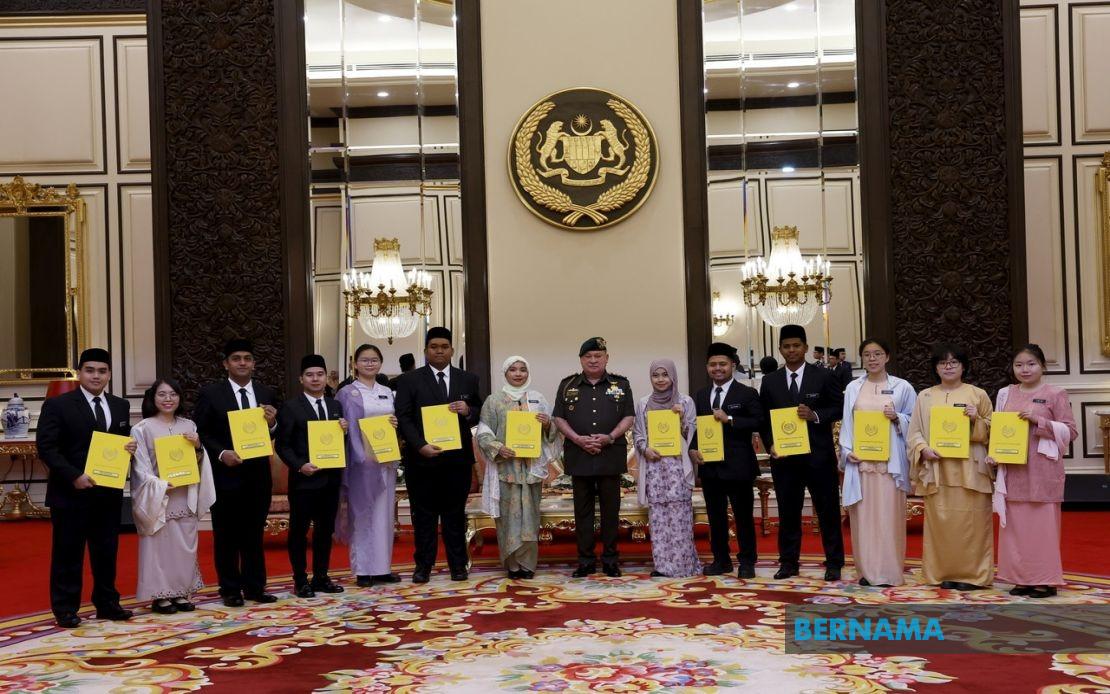
His Majesty Sultan Ibrahim, King of Malaysia, has conferred the 2026 Yang di-Pertuan Agong Scholarships (BYDPA) upon 14 recipients in a formal ceremony conducted at Istana Negara in Kuala Lumpur on June 24, recognising their exceptional academic merit and research potential. The presentation marks another year in the royal scholarship programme's long-standing tradition of nurturing Malaysia's most talented postgraduate scholars across disciplines spanning science, technology, engineering, humanities, and social sciences.
The cohort of recipients comprises two distinct groups pursuing advanced research qualifications. Half of the scholarship holders have been selected to undertake PhD programmes, while their counterparts will pursue postgraduate research at the Master's level, reflecting the scheme's commitment to developing scholars across the full spectrum of postgraduate research pathways. This balanced allocation underscores the BYDPA's strategic focus on building Malaysia's research capacity by investing in both early-career doctoral researchers and those seeking advanced mastery in their chosen fields.
Geographically, the scholarship distribution reveals the scheme's dual emphasis on international academic excellence and strengthening local research institutions. Four of the 14 recipients will pursue their studies at renowned universities abroad, broadening Malaysia's intellectual networks and positioning the nation's researchers within global academic communities. The remaining ten scholars will conduct their research at domestic universities classified as research-intensive institutions, a deliberate policy choice designed to elevate the calibre of Malaysia's own higher education ecosystem and retain top talent within the country's academic sector.
The BYDPA stands as one of Malaysia's most prestigious and generously funded government scholarship programmes, according to remarks made by Tan Sri Wan Ahmad Dahlan Abdul Aziz, the Director-General of the Public Service, who attended the ceremony alongside Tan Sri Dr Azmi Rohani, Comptroller of the Royal Household at Istana Negara. The scholarship's prominence within Malaysia's educational landscape reflects its strategic importance to the government's human capital development agenda and its role in cultivating the next generation of researchers, academics, and thought leaders who will shape the nation's intellectual and scientific future.
The funding provided through the BYDPA programme ranks among the most substantial available through government-backed scholarship schemes in Malaysia, offering recipients comprehensive financial support that typically encompasses tuition fees, living allowances, research expenses, and other educational costs necessary for sustained engagement in advanced postgraduate research. This generous funding model removes significant financial barriers that might otherwise impede talented but economically disadvantaged Malaysians from pursuing doctoral and advanced research qualifications, thereby democratising access to elite postgraduate education.
The selection process for BYDPA recipients involves rigorous evaluation of academic credentials, research proposal quality, and demonstrated potential to contribute meaningfully to Malaysia's research and development agenda. The scholarship committee considers not merely academic excellence but also the applicant's alignment with national priorities in sectors including STEM, healthcare innovation, agricultural advancement, and social policy research. By curating its recipient cohort according to these criteria, the BYDPA ensures that its investment translates into tangible benefits for Malaysia's economic competitiveness and social development objectives.
For Southeast Asian observers, Malaysia's continued investment in postgraduate research scholarships signals regional recognition that advanced human capital development remains central to economic modernisation and knowledge-economy transition. As regional nations compete for expertise in emerging fields such as artificial intelligence, biotechnology, renewable energy, and data science, scholarship programmes like the BYDPA serve as essential instruments for building institutional capability and attracting high-calibre researchers. The programme's emphasis on both doctoral training and Master's-level research reflects sophisticated understanding that diverse research pathways contribute to varied but equally valuable forms of innovation and knowledge generation.
The distinction between domestic and international study placements within the BYDPA framework illustrates Malaysian policymakers' nuanced approach to research capacity building. By funding scholars at leading universities worldwide, Malaysia gains access to cutting-edge knowledge and methodologies while simultaneously building international academic networks. Conversely, channelling substantial scholarship resources toward local research universities strengthens their competitive positioning, attracts ambitious scholars, and helps transition Malaysian institutions toward research-intensive models that generate original knowledge and innovation rather than primarily absorbing international expertise.
The ceremony's participation by senior civil service and royal household officials underscores the BYDPA's status as a flagship initiative receiving high-level institutional commitment. This official prominence signals to both recipients and prospective applicants that postgraduate research represents a valued national endeavour deserving significant public investment and royal patronage. The ceremonial presentation tradition reinforces cultural messaging that academic excellence and research contributions command respect and recognition within Malaysian society, potentially influencing broader social attitudes toward scholarly pursuits and intellectual achievement.
Looking forward, the 2026 cohort of BYDPA scholars will contribute to Malaysia's expanding research landscape across multiple dimensions. Some recipients will establish themselves as specialists in their respective fields, potentially becoming future academic leaders and research supervisors who train subsequent generations of Malaysian scholars. Others may transition into policy advisory roles, industry research positions, or innovation-focused entrepreneurship, applying their advanced training to practical challenges confronting Malaysian society and economy. The aggregate impact of such individual trajectories compounds over decades, gradually repositioning Malaysia's global standing in research rankings and knowledge output metrics that increasingly define national competitive advantage in the global economy.