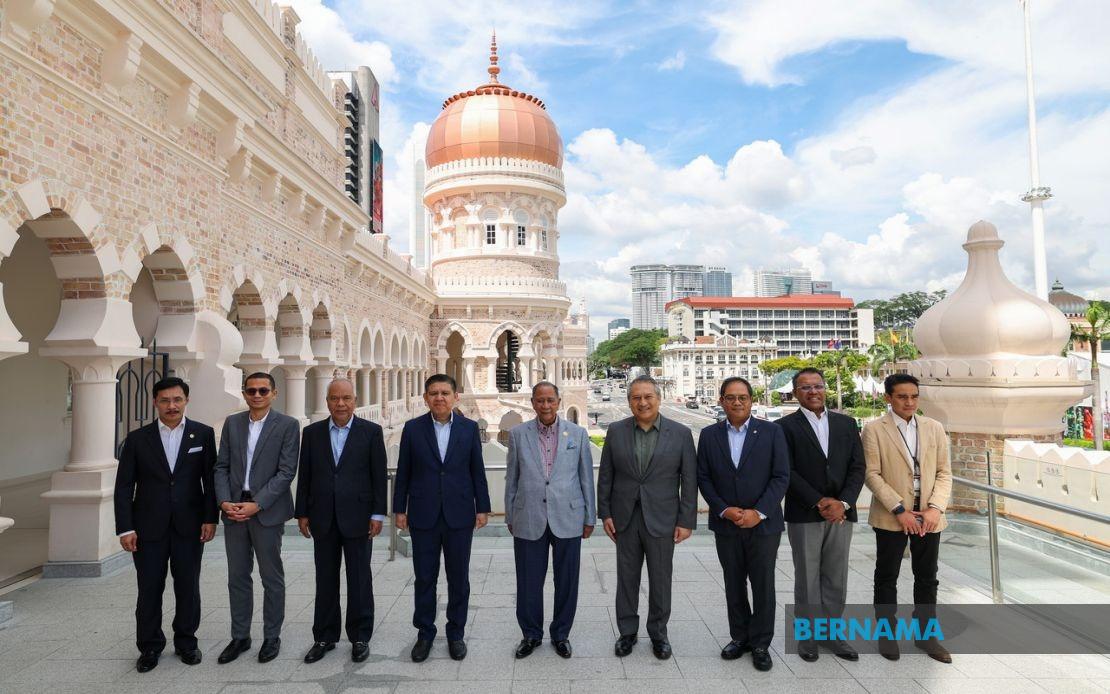
The Sultan of Kedah, Al Aminul Karim Sultan Sallehuddin Sultan Badlishah, made an official visit to the Sultan Abdul Samad Building in Kuala Lumpur on June 24, underscoring the enduring importance of Malaysia's most iconic heritage structure. Arriving shortly after 10.30 am, His Royal Highness was received by Khazanah Nasional managing director Datuk Amirul Feisal Wan Zahir, accompanied by senior officials including chief corporate officer and general legal adviser Datuk Mohamed Nasri Sallehuddin and head of real assets Selvendran Katheerayson. The visit highlighted the significance that Malaysia's royal institution places on the preservation and public appreciation of the nation's architectural heritage.
The Sultan's itinerary encompassed a comprehensive tour of the building's newly restored galleries, beginning with the Confluence Hall, where exhibits document the origins and development of Kuala Lumpur from its early trading settlement to its emergence as a modern metropolis. Think City senior manager Mariana Isa conducted the briefing, explaining how the displays trace the city's transformation through various phases of growth and urbanisation. This hall serves as the foundation for understanding Kuala Lumpur's historical trajectory, providing visitors with context about the geographical, economic, and social factors that shaped the capital's evolution.
Following the Confluence Hall, His Royal Highness proceeded to the Visionary Hall, which takes the narrative forward through contemporary multimedia presentations and architectural models illustrating the city's future development plans. This gallery represents a bridge between historical understanding and forward-looking urban vision, demonstrating how Kuala Lumpur continues to position itself as a dynamic Southeast Asian capital. The Sultan subsequently visited the balcony overlooking the Porte Cochere, the building's distinctive arched entrance, which remains one of the most recognisable architectural features in Malaysia and a symbol of the nation's imperial past and its transition to independence.
The royal agenda also included a visit to the School of Hard Knocks, an enterprise operated by Royal Selangor that combines heritage appreciation with contemporary craft and cultural programming. His Royal Highness attended a light luncheon before departing the building at approximately 1.15 pm, concluding what Khazanah officials characterised as a significant endorsement of their conservation work. The visit's structured nature and broad coverage of the building's various spaces reflected careful planning to showcase the comprehensive restoration undertaken at the site.
Amirul Feisal stressed that the royal visit carried profound symbolic value beyond ceremonial protocol. He noted that the presence of the Kedah Sultan acknowledged Khazanah Nasional's commitment to preserving the Sultan Abdul Samad Building not merely as an architectural monument but as a repository of national historical consciousness. The preservation initiative, he explained, extends considerably beyond the technical aspects of structural conservation to encompass the active curation and presentation of Malaysia's historical narrative, making the building a functioning educational and cultural institution rather than merely a preserved relic.
Since opening to the general public on February 2 following Phase One restoration works, the Sultan Abdul Samad Building has attracted approximately 200,000 visitors, indicating substantial public interest in engaging with Malaysia's heritage. This visitor volume suggests that the building's reopening has successfully positioned it as a significant cultural destination within Kuala Lumpur's tourism and educational landscape. The figures underscore the appetite among Malaysians and international visitors to experience and understand the physical spaces where pivotal moments in national history occurred.
The restoration project itself represents a major national investment in heritage preservation. On January 31, His Majesty Sultan Ibrahim, King of Malaysia, officially inaugurated the completion of Phase One restoration works, which encompassed eleven months of intensive conservation efforts conducted under the auspices of the Khazanah Heritage Fund programme. This royal endorsement at the highest level demonstrates the Malaysian monarchy's active engagement with heritage preservation and the cultural continuity of the nation.
The Sultan Abdul Samad Building carries immense historical weight in Malaysia's collective memory and constitutional development. Originally constructed as the Secretariat Building during the colonial period, it functioned as the administrative nerve centre of British Malaya and subsequently of independent Malaya and Malaysia. Most significantly, the building witnessed the symbolic moment in 1957 when the Union Jack was lowered and the Federation of Malaya flag was raised for the first time, marking the nation's transition to independence and the commencement of a new era in Southeast Asian geopolitics. This historical association ensures that any activity within or relating to the building carries resonance beyond ordinary heritage preservation.
For Malaysian readers and the broader Southeast Asian context, the Kedah Sultan's visit carries particular importance as it reflects how Malaysia's federal structure and constitutional monarchy actively engage with heritage preservation across different states. The visit by the ruler of one of Malaysia's oldest sultanates to a building situated in the federal territory demonstrates the interweaving of state and federal identities within Malaysia's complex constitutional framework. The Sultan Abdul Samad Building, while located in Kuala Lumpur, represents not just federal history but the collective experience of peninsular Malaysia's transition from colonial administration to independent statehood.
The restoration and reopening of the Sultan Abdul Samad Building also speaks to broader regional trends in heritage conservation and cultural tourism within Southeast Asia. As regional cities increasingly compete for cultural tourism revenue and seek to establish distinctive identities rooted in historical authenticity, the preservation and activation of heritage buildings becomes a strategic consideration for urban development. Malaysia's investment in restoring and opening this building to public engagement positions it competitively within a regional ecosystem where heritage tourism contributes significantly to cultural and economic development.
The multi-functional approach evident in the building's reopening—combining galleries with educational programming, hospitality services, and contemporary cultural enterprises—reflects modern best practices in heritage site management. Rather than preserving the building as a static museum, Khazanah Nasional has created a living space where history is actively interpreted and where contemporary cultural production occurs within a heritage context. This approach enhances the building's relevance to contemporary Malaysians while maintaining scholarly rigor in the presentation of historical narratives.
Looking forward, the continued royal patronage and public engagement demonstrated by the Kedah Sultan's visit suggests that Phase Two restoration works and further developments at the Sultan Abdul Samad Building will proceed with strong institutional support. The building's trajectory from administrative headquarters to heritage landmark to public cultural institution illustrates how Malaysian society continues to negotiate its relationship with colonial-era architecture and the historical periods they represent. Rather than erasure or deprecation, the approach has been one of contextualisation and reinterpretation, allowing Malaysians to engage critically with their historical inheritance while celebrating the nation's achievement of independence and subsequent development.

