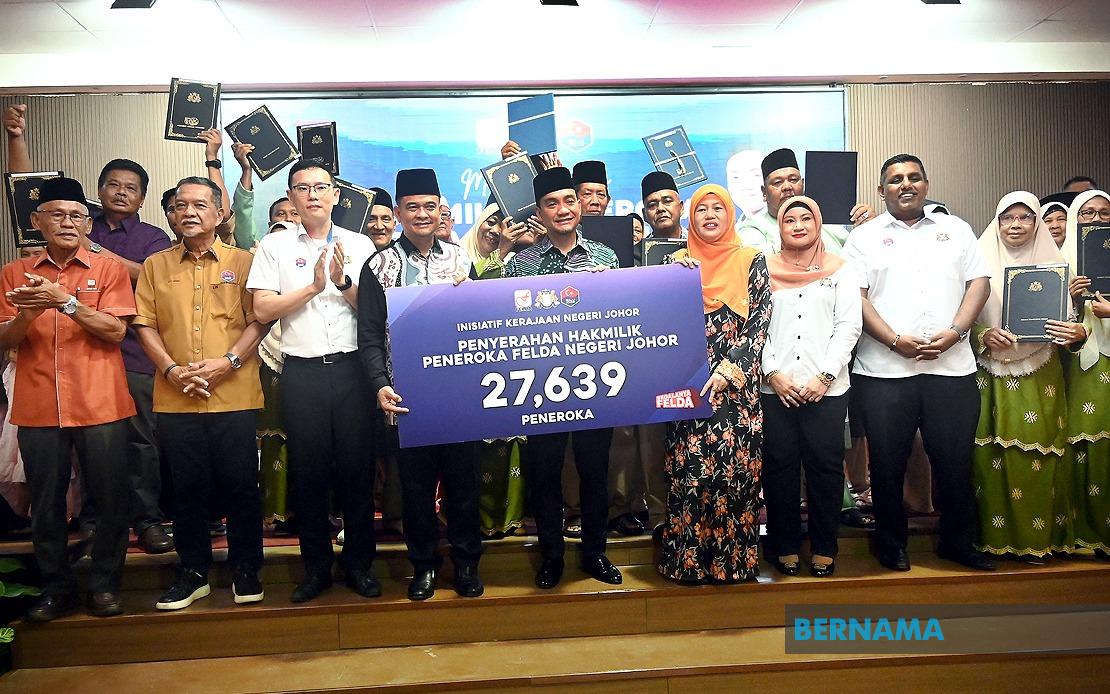
The Johor state government has effectively concluded a protracted dispute over land ownership that has shadowed Federal Land Development Authority (FELDA) communities for generations. Menteri Besar Datuk Onn Hafiz Ghazi announced at a land title presentation ceremony in Kluang that 27,639 applications out of 27,642 had been processed and approved, representing a 99.99 per cent resolution rate. This accomplishment addresses what has long been a source of anxiety for FELDA settlers across three districts—Kluang, Kota Tinggi, and Mersing—who have operated their smallholdings without formal proof of ownership.
The significance of this milestone extends beyond mere administrative completion. Land titles form the bedrock of rural economic participation, enabling farmers to leverage their property as collateral for financing, to plan long-term agricultural investments with confidence, and to transfer assets to their descendants with legal certainty. For FELDA settlers, many of whom represent Malaysia's pioneering rural development efforts dating back decades, the absence of clear title has represented a structural handicap in their capacity to modernise their operations or weather economic challenges. This resolution therefore unlocks genuine economic potential within communities that have historically operated at the margins of Malaysia's financial system.
The presentation ceremony itself delivered immediate tangible results, with 210 settlers formally receiving their land title documents across the three districts. This cohort represents the culmination of systematic processing by the state government, which appears to have maintained momentum despite the administrative complexity inherent in validating ownership claims across thousands of individual plots. The structured approach—holding a dedicated ceremony to mark the occasion—suggests institutional commitment rather than bureaucratic indifference, signalling to remaining FELDA communities that their grievances are being taken seriously at the highest levels of state administration.
Datak Onn Hafiz Ghazi framed this achievement within the broader context of Johor's rural development agenda, emphasizing that FELDA settlements would continue to receive priority treatment from his administration. This rhetorical positioning is strategically significant, as it positions land title resolution not as a one-off corrective measure but as an integral component of sustained rural policy. The statement that the state government would continue treating FELDA communities as a priority carries implicit recognition that rural development requires ongoing attention, not episodic interventions. Such assurances matter considerably in communities where previous governments have made promises that remained unfulfilled.
The persistence of land title disputes within FELDA schemes reflects historical gaps in the original settlement architecture. When FELDA schemes were first established in the 1950s and 1960s as instruments of rural development and poverty alleviation, the institutional frameworks for title registration were neither as sophisticated nor as comprehensive as contemporary standards. Many settlers obtained occupancy rights without the corresponding documentation that would constitute modern proof of ownership. Resolving these anachronisms has required painstaking verification of historical records, boundary surveys, and coordination between state land offices and FELDA itself—explaining why this issue has persisted across multiple administrations and decades.
For Malaysia's broader development narrative, the Johor resolution carries relevance beyond state boundaries. FELDA settlements exist throughout Peninsular Malaysia, and comparable title disputes likely persist in other states. The Johor government's successful processing of over 27,000 applications demonstrates that systematic resolution is feasible, potentially providing a template for other state administrations grappling with similar backlogs. Should Johor's experience be studied and replicated elsewhere, the cumulative effect could extend land ownership security to tens of thousands of additional rural families across the nation.
The participation of Datuk Zahari Sarip, the Johor Agriculture, Agro-based Industry and Rural Development Committee chairman, underscores the cross-functional coordination required for successful implementation. Land title resolution inherently involves multiple government agencies—state land offices, FELDA administration, local government bodies, and potentially revenue departments. The presence of the relevant committee chairman suggests institutionalized oversight and accountability mechanisms, reducing the likelihood of processing delays or inconsistent application of procedures.
From a practical standpoint, land title security opens concrete pathways for FELDA communities to participate in modern agricultural financing. Formal ownership enables settlers to access agricultural credit schemes previously unavailable to them, to purchase modern equipment through formal lending arrangements, and to participate in agricultural cooperatives or contract farming arrangements that increasingly characterize Malaysia's commercial agricultural landscape. This financial inclusion represents the tangible economic dividend that flows from mere administrative action.
The near-complete resolution rate—leaving only three unresolved cases from 27,642—indicates that the Johor government has managed what is often an extremely difficult administrative task: moving from conceptual commitment to concrete results. The three remaining cases likely involve exceptional complexity—disputes between multiple claimants, historical documentation gaps, or boundary ambiguities—rather than systemic processing failures. Addressing these final outliers will require targeted investigation rather than wholesale procedural revision.
Looking forward, the challenge for the Johor state government lies in maintaining the institutional attention required to resolve those final three applications while simultaneously ensuring that no new title disputes emerge from the FELDA settlements. This necessitates ongoing coordination with FELDA administration and clear procedures for handling any future land-related claims from settlers. The precedent set by this 99.99 per cent resolution rate establishes public expectations that land title matters will receive priority handling, creating reputational incentives for sustained administrative performance.
The resolution of this longstanding issue also carries political dimensions for Johor's administration. Delivering tangible improvements to rural communities represents solid governance ground, building credibility particularly among constituencies that have historically felt neglected by development priorities concentrated in urban areas. For FELDA settlements that span multiple electoral constituencies, demonstrating responsiveness to their legitimate grievances translates into political capital—a reminder that rural constituencies, while less populous than urban centres, remain strategically important in Malaysia's democratic system.
Ultimately, Johor's near-complete resolution of FELDA land title applications represents the successful conclusion of an obligation that should have been fulfilled far earlier. However, it also demonstrates that when political will aligns with administrative capacity, even deeply entrenched problems can be substantially resolved. For the 27,639 FELDA settlers who have now received formal land titles, and for the millions of rural Malaysians still navigating developmental challenges, this achievement offers both practical relief and symbolic proof that systematic attention to rural grievances can produce meaningful results.