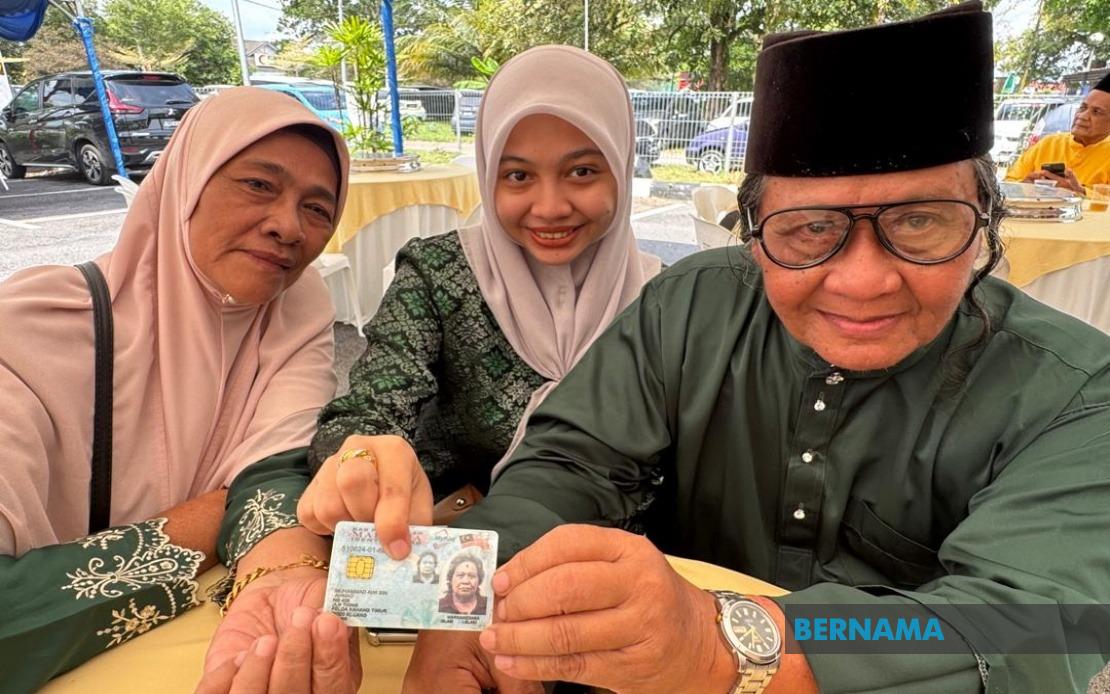
A milestone moment arrived for Muhammad Awi Ahmad on his 75th birthday when he finally received the ownership documents to his 4.2-hectare plantation and home in Felda Kahang Timur. After submitting three separate applications spanning three decades—in 1990, 2000, and most recently within the past year—the Johor state government under Menteri Besar Datuk Onn Hafiz Ghazi approved his claim, bringing closure to an exhausting bureaucratic journey that had defined much of his adult life.
The ceremony held at Dewan Dato' Onn in Rumah Komuniti Parlimen Sembrong distributed titles to 210 recipients from Kluang, Kota Tinggi and Mersing, representing a significant step in addressing what has been a persistent source of anxiety for plantation families in the state. For settlers who invested decades cultivating their plots, the absence of formal ownership created profound uncertainty about their future security and their ability to pass assets to subsequent generations. Muhammad Awi's emotional response—describing the title as the perfect birthday present—underscored the deep personal significance these documents hold beyond mere legal paperwork.
The experience of Mohd Farhan Mohamad illustrates the generational dimension of this struggle. At 43, he initiated the application process in 2006 with the specific aim of fulfilling his father Mohamad Masek's wish to secure ownership of land cultivated since the 1980s. When their resubmission last year unexpectedly gained approval, it represented vindication not only for Mohd Farhan but for his aging father, whose lifetime of labour on the plantation could finally be formally acknowledged through legal ownership.
The voices of younger settlers reveal a critical concern extending beyond the first generation. Norliyani, Muhammad Awi's 25-year-old daughter, articulated how unresolved land ownership directly threatens the security of second and third-generation Felda families. While elderly settlers retain the option of returning to ancestral villages, younger families like hers have no alternative homeland—Felda communities represent their entire inheritance and future livelihood. Without formal titles, the accumulated family wealth built through decades of agricultural labour could legally pass to others, undermining generational stability.
This intergenerational perspective highlights why the Johor government's initiative addresses not just a historical grievance but a prospective threat to social cohesion within Felda communities. Norliyani's concern that unresolved ownership could allow family land to fall into external hands captures a deeper anxiety about dispossession and erosion of settler communities' economic foundations. The title distribution therefore functions as a protective measure for young families whose connection to the land depends entirely on their parents' formal legal claim.
The scale of the achievement becomes apparent in the statistics: 99.9 per cent of 27,642 Johor Felda settlers who submitted applications have now received ownership titles, translating to 27,639 individuals. This near-universal success rate represents a dramatic reversal from the decades-long impasse that characterized earlier years. The timeline of Muhammad Awi's failed applications in 1990 and 2000 suggests the process remained stubbornly obstructed until recent policy shifts enabled rapid processing.
The acceleration from application to approval—completing Muhammad Awi's final submission within approximately one year—demonstrates a fundamental change in administrative approach under the current Johor administration. This represents not merely bureaucratic efficiency but a deliberate prioritization of settler welfare. The visible commitment evident in Menteri Besar Onn Hafiz Ghazi's attendance at the ceremony underscores that land security for Felda communities has become a stated policy objective rather than a perpetually deferred problem.
For Malaysia's broader Felda framework, this Johor resolution carries significant implications. Felda settlements have historically served as mechanisms for rural development and resource redistribution, yet the denial of formal ownership titles undermined these objectives by creating a precarious underclass of cultivators without legal security. The Johor initiative suggests a reorientation toward completing the original social contract implicit in Felda's establishment—granting settlers not merely usage rights but actual ownership reflecting their decades of labour.
The emotional weight Muhammad Awi attached to receiving his title on his 75th birthday encapsulates a broader narrative of deferred justice. At an age when most would expect to consolidate lifetime achievements, he finally obtained legal recognition of his life's primary accomplishment. This telescoping of his waiting period into a single birthday moment symbolizes how Felda settlers experienced their struggle—as an indefinite postponement of a basic right that should have been granted far earlier.
The implementation of this initiative across Kluang, Kota Tinggi and Mersing indicates it extends beyond a single locality, suggesting systematic rather than ad-hoc resolution. The concentration of 210 titles in three administrative areas demonstrates capacity for coordinated processing and reflects earlier applications that had languished without resolution. The fact that this ceremony marks a turning point, not a completion, suggests ongoing work to finalize remaining cases and establish maintenance systems for future generations.
Mohd Farhan's delayed gratification—waiting seventeen years from initial application to approval—reveals the institutional inertia that characterized the previous system. His surprise at the approval despite optimistic resubmission suggests expectations had been recalibrated downward by repeated disappointments. This shift from resigned expectation of rejection to genuine receipt of titles represents a psychological as well as legal transformation for settler families.
Looking forward, the near-complete resolution in Johor establishes a template potentially relevant for other states managing Felda populations. The success in achieving 99.9 per cent coverage demonstrates that universal ownership titling is administratively feasible when prioritized. For second and third-generation settlers like Norliyani, these titles provide the platform for agricultural modernization, credit access, and genuine wealth accumulation—transforming Felda from a welfare framework into a foundation for participatory agricultural development.