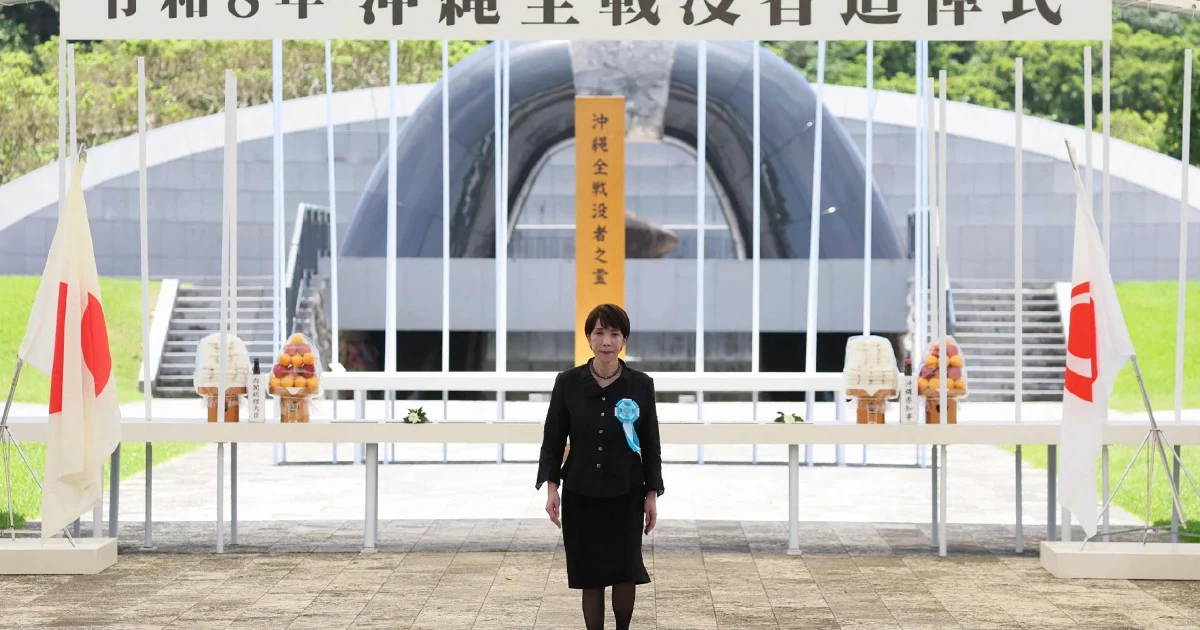
Prime Minister Sanae Takaichi faced direct confrontation from demonstrators at a World War II memorial event in Tokyo, marking a visible clash between Japan's leadership and those who fear the nation is abandoning its pacifist foundations. Television coverage captured the tense moments as protesters voiced their concerns about the government's increasingly assertive military direction, underscoring the deep divisions within Japanese society over how the country should position itself in an uncertain geopolitical landscape.
Takaichi, who assumed office as Japan's prime minister, has inherited a complex national security challenge. The hecklers at the memorial reflected widespread anxiety among pacifist-minded Japanese citizens and civil society groups who view recent policy developments with alarm. These concerns are rooted in Japan's post-war constitutional framework, which has deliberately constrained military capability and emphasized diplomatic solutions to international disputes for over seven decades.
The incident highlights the generational and ideological fault lines that persist in Japanese politics regarding defence policy. Older Japanese, particularly those with living memories of wartime destruction, have traditionally championed pacifism as essential to national identity and as a safeguard against repetition of historical tragedy. Meanwhile, policymakers increasingly argue that Japan's changing security environment—particularly regarding regional tensions and great power competition—demands a recalibration of military and defence capabilities.
Japan's gradual shift away from strict pacifism has accelerated considerably in recent years. The government has pursued incremental changes to defence spending, expanded the scope of military activities, and revisited constitutional interpretations that previously limited military action. These moves reflect Tokyo's response to China's military modernization, North Korea's persistent nuclear and missile programmes, and broader concerns about the stability of the American security umbrella that has underpinned Japanese stability since 1945.
For Southeast Asian nations, Japan's military evolution carries significant implications. Regional countries maintain intricate security relationships with Tokyo and depend partly on Japan's stability and balanced approach to security matters. Any perception of Japan becoming more militaristic could reverberate throughout the region, affecting strategic calculations and alliance dynamics. Southeast Asian governments carefully monitor whether Japan's moves represent reasonable security adaptation or represent a concerning departure from its historical restraint.
The confrontation at the war memorial reflects broader concerns about transparency and consultation in Japan's security policy deliberations. Civil society groups argue that transformative shifts in military posture deserve wider public debate and clearer justification. The memorial setting itself—commemorating the human costs of armed conflict—amplified the emotional resonance of the protest, positioning opposition to military expansion as continuous with Japan's postwar commitment to preventing future wars.
Takaichi's administration faces the challenge of pursuing security policies it views as necessary while maintaining social cohesion and respecting Japan's pacifist traditions. This balancing act has become increasingly difficult as external pressures mount. Regional instability, economic concerns, and questions about Japan's demographic future all intersect with defence questions, making security policy far more complex than simple binary choices between pacifism and militarism.
The incident also reflects Japan's vibrant civil society tradition and capacity for public contestation. Unlike many regional neighbours, Japanese citizens enjoy freedom to protest government policies openly, and the fact that opposition voices can be heard at official ceremonies indicates an ongoing democratic conversation about national direction, even when that conversation becomes contentious.
International observers note that Japan faces genuine dilemmas without clear solutions. A purely pacifist stance might leave Japan vulnerable to coercion or unable to contribute meaningfully to regional stability. Conversely, excessive militarization could destabilize regional security dynamics and undermine Japan's economic interests. Japan's policymakers must navigate between these poles while addressing legitimate public concerns about maintaining the nation's peaceful character.
The heckling incident, while dramatic, reflects a wider phenomenon across the region where countries grapple with security modernization. Several Southeast Asian nations similarly wrestle with how to strengthen defence capabilities without alarming neighbours or betraying national values. Japan's experience offers instructive lessons about the importance of transparent policymaking and maintaining public trust during strategic transitions.
Looking forward, Takaichi's government will likely face continuing scrutiny from civil society as it pursues defence initiatives. The government's capacity to explain and justify security decisions to a skeptical public will prove crucial for maintaining national consensus. Successfully navigating between security necessity and pacifist heritage represents one of Japan's most consequential challenges as it shapes its role in an increasingly multipolar Asia-Pacific region where Japan's choices reverberate across multiple security architectures and alliance networks.