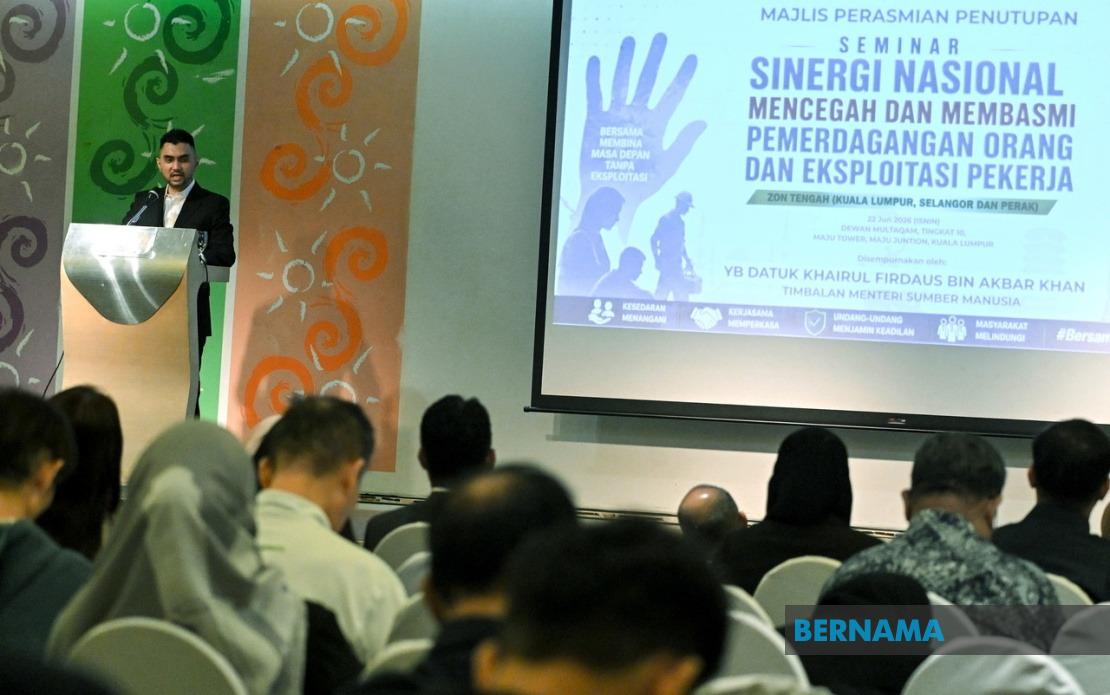
The number of trafficking and labour exploitation victims rescued in Malaysia has declined significantly over the past two years, suggesting that coordinated government crackdowns are producing measurable results in combating one of Southeast Asia's most persistent human rights challenges. Speaking at the National Synergy Seminar on Preventing and Eradicating Human Trafficking and Labour Exploitation in the Central Zone in Kuala Lumpur on June 22, Deputy Human Resources Minister Datuk Khairul Firdaus Akbar Khan unveiled statistics showing that rescue operations are becoming more effective, though he cautioned that behind the improving headline figures lies a darker reality that authorities have yet to fully illuminate.
The Peninsular Malaysia Manpower Department (JTKSM) recorded a sharp trajectory in rescue figures that tells a story of both progress and uncertainty. In 2023, rescuers freed 70 victims from trafficking and labour exploitation situations across the peninsula. This fell dramatically to just 10 people in 2024, a 86 per cent drop that initially suggests a significant breakthrough in prevention. However, the figures for 2025 show a reversal of that trend, with 17 victims rescued, while only four cases had been processed by May of the current year. Rather than interpreting the overall decline as an unqualified success, Datuk Khairul Firdaus offered a more nuanced assessment, acknowledging that the government can take modest satisfaction in the reported numbers while recognising that vast swathes of trafficking activity likely remain invisible to authorities.
This caution reflects a uncomfortable truth facing enforcement agencies across the region: reported cases represent only the tip of an iceberg. Trafficking networks have become increasingly sophisticated at concealing their operations, moving victims between jurisdictions and exploiting vulnerabilities in detection systems. The possibility that falling rescue numbers merely indicate better hiding practices rather than genuine elimination of the crime cannot be dismissed. In Malaysia's context, where migrant workers and vulnerable populations face systematic exploitation, the gap between official statistics and ground reality remains a significant policy challenge. Datuk Khairul Firdaus's explicit warning that "there may be things that we do not see (not reported), so we cannot take it lightly" reflects a maturity in government thinking that acknowledges the limitations of enforcement data alone.
To demonstrate the scale of operational response, the deputy minister highlighted that from January to May alone, authorities conducted 386 enforcement operations focused on labour violations nationwide. These operations resulted in the opening of 311 investigation papers, indicating that while victim rescues may be numerically modest, the underlying investigative machinery remains actively engaged. This distinction between rescue numbers and investigation activity suggests a shift in strategy toward prosecution and prevention rather than simply identifying and processing victims. The breadth of these enforcement efforts across the peninsula indicates that the government is attempting to address trafficking systematically rather than responding to isolated incidents.
Malaysia's commitment to combating forced labour has been reinforced through its ratification of International Labour Organisation (ILO) protocols, placing the country within a global framework that establishes enforceable standards. This alignment with international norms creates pressure on Malaysian authorities to maintain rigorous standards and contributes to the government's stated agenda in confronting forced labour. The ILO framework also provides access to best practices, technical assistance, and comparative data from other nations wrestling with similar challenges. For Malaysia, which serves as both a destination and transit point for trafficked persons from across Southeast Asia, this international alignment carries particular weight in the regional context.
Beyond enforcement operations, the government has invested in awareness and prevention through a series of regional seminars designed to educate stakeholders and gather intelligence. The National Synergy Seminar programme, which concluded its Central Zone iteration in Kuala Lumpur, represents an attempt to build institutional knowledge and cross-sector coordination. Prior sessions were held in the North Zone at Sungai Petani, Kedah on May 18 and in the South Zone at Kluang, Johor on June 8, creating a geographically distributed approach to raising awareness. Across these three major regional seminars, approximately 1,000 participants from various sectors attended, creating forums for sharing intelligence, discussing vulnerabilities, and coordinating responses.
The participation of nearly 1,000 individuals in these seminars underscores a recognition that combating trafficking requires multi-sectoral engagement. Educators, labour inspectors, social workers, law enforcement, business leaders, and civil society representatives all bring different perspectives and information to bear on the problem. This collaborative model acknowledges that trafficking thrives in environments where different sectors operate in isolation, allowing criminals to exploit gaps between systems. By creating platforms for dialogue and coordination, authorities aim to tighten the net around trafficking operations and improve victim identification protocols. The seminar structure also signals to stakeholders that human trafficking is a priority issue worthy of sustained government attention and resource allocation.
For Malaysia and the broader Southeast Asian region, human trafficking remains a challenge that defies easy resolution through enforcement alone. The country's position as an economic hub with significant foreign worker populations creates conditions that can be exploited by trafficking networks. Myanmar, Cambodia, Laos, and the Philippines are all significant source countries for trafficked persons, many of whom transit through Malaysia toward destination countries in East Asia, the Middle East, and beyond. This regional dimension means that Malaysian efforts exist within a broader ecosystem of supply and demand that extends beyond national borders. Improving coordination with neighbouring countries, establishing better victim support mechanisms, and addressing root causes of vulnerability in source countries all represent components of a comprehensive strategy that Malaysia must navigate.
The declining rescue figures, when viewed against the backdrop of ongoing enforcement operations and awareness initiatives, suggest that the government is making progress in tightening enforcement mechanisms. However, the explicit caution voiced by Datuk Khairul Firdaus reflects an understanding that statistical decline does not necessarily equate to problem reduction. Trafficking operations may be becoming harder to detect through adaptation and evasion rather than through genuine elimination. This recognition should inform future policy decisions, potentially tilting priorities toward prevention of vulnerability in source communities, strengthening victim support systems, and enhancing cross-border cooperation. Without such comprehensive approaches, enforcement victories may prove pyrrhic, merely pushing criminal networks to more clandestine operations rather than dismantling the fundamental conditions that enable human trafficking to flourish. Malaysia's challenge in the coming years will be to maintain the momentum in enforcement while building the preventive infrastructure necessary to address trafficking at its roots.