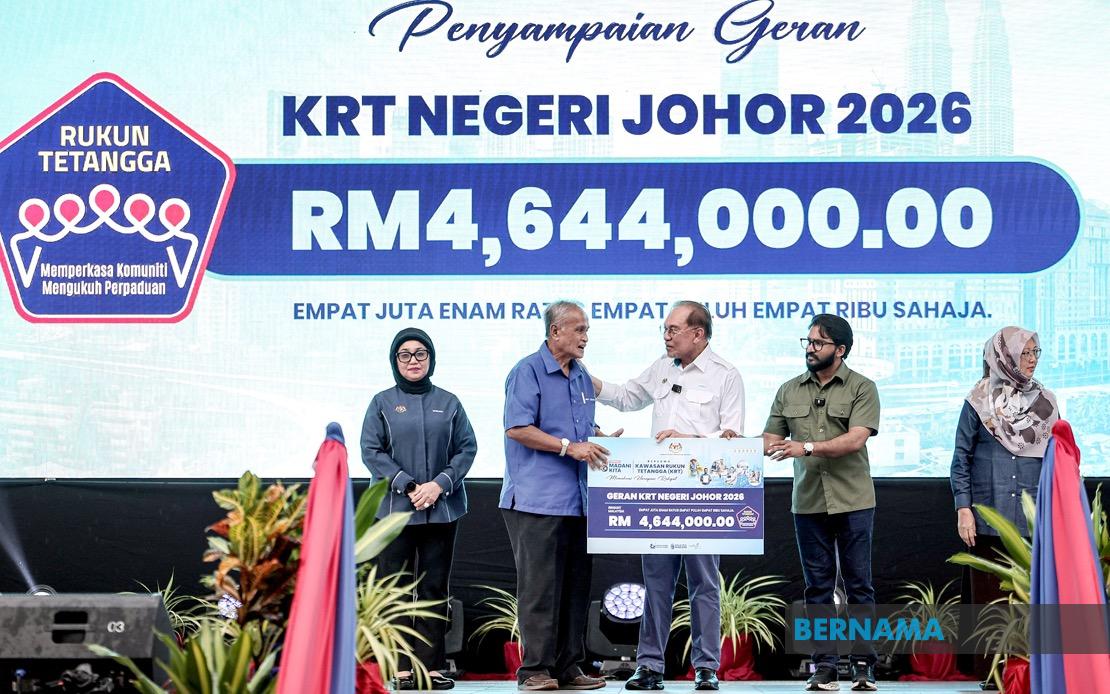
Prime Minister Datuk Seri Anwar Ibrahim has announced a substantial boost to grassroots community policing across Malaysia, approving an increase in annual grants for Neighbourhood Watch Areas (KRT) to RM10,000 from the existing RM6,000. The enhanced allocation will take effect from January 1, 2027, and represents a 67 percent jump in funding for these vital community organisations that have operated at the same funding level for the past decade. The decision was unveiled at the MADANI KITA Programme held at Dataran Segamat, where the Prime Minister emphasised the critical importance of strengthening these neighbourhood-level institutions as partners in addressing societal challenges.
The decade-long freeze on KRT grants has become increasingly difficult to justify given the rising costs of community activities and initiatives. By maintaining the RM6,000 allocation unchanged since 2017, the purchasing power of these funds has steadily eroded through inflation, effectively reducing the real value of government support. Anwar's decision acknowledges this reality and signals recognition that KRT organisations play a substantive role in bridging government and communities at the neighbourhood level. The new amount will provide these groups with greater capacity to conduct activities, purchase necessary materials, and sustain their operational needs without depending entirely on voluntary contributions from members.
At the heart of the government's rationale lies a commitment to revitalising community consensus and democratic participation at the grassroots. According to Anwar, KRT organisations serve as crucial intermediaries that help revive the spirit of unity and cooperative problem-solving whilst simultaneously assisting security personnel and government departments in addressing community welfare concerns. This partnership model reflects an understanding that top-down governance alone cannot effectively manage the complex social dynamics that exist within neighbourhoods. By empowering KRT groups with improved resources, the government aims to strengthen their capacity to organise activities, facilitate dialogue amongst residents, and serve as an early warning system for emerging social tensions or security issues.
The timing of this announcement carries particular significance for Malaysia's social cohesion agenda. Anwar reminded attendees that the nation's distinctive strength derives from its ability to maintain harmony across racial, cultural, and religious lines since independence. In a region where communal tensions periodically surface, sustaining neighbourhood-level organisations that bring diverse residents together through shared civic purposes becomes strategically important. KRT groups, by their very nature, operate at a scale where interpersonal relationships and trust-building can occur naturally, making them ideal platforms for practising the values of tolerance and mutual respect that national unity requires.
Beyond the KRT funding announcement, the Prime Minister utilised the Segamat visit to unveil complementary investments in community infrastructure and public sector welfare. An immediate allocation of RM3.205 million was approved for basic infrastructure repairs at 16 Islamic educational institutions across Johor, including facilities in Batu Pahat, Muar, and Segamat. These upgrades affect religious schools, madrasahs, study centres, and tahfiz institutions, reflecting a government strategy to improve the physical learning environment where tens of thousands of students receive Islamic education. The investment acknowledges that educational excellence depends partly on facility quality, and that students from these institutions deserve learning spaces comparable to other government-funded schools.
The allocation for Islamic educational institutions also demonstrates the MADANI Government's commitment to inclusivity in infrastructure spending. Religious educational establishments have historically received less consistent funding attention compared to secular schools, and this targeted investment signals a policy shift toward equitable resource distribution. For Malaysian families who choose Islamic educational pathways for their children, particularly in rural and semi-urban areas like those targeted in Johor, improved facilities translate into concrete improvements in daily school experiences and educational outcomes.
Simultaneously, Anwar approved RM1.0 million in immediate funding for critical and urgent repairs at Royal Malaysian Police quarters in Johor. This allocation reflects a broader understanding that personnel welfare directly impacts the effectiveness and morale of security services. Police officers and their families living in substandard quarters face practical hardships that can affect job performance and retention. By addressing facility deficiencies systematically, the government aims to demonstrate commitment to those who bear direct responsibility for maintaining public order and national security.
These three funding announcements—KRT grants, Islamic educational institutions, and police quarters—collectively represent a multi-layered approach to strengthening community-level governance and social infrastructure. Rather than concentrating resources in major urban centres or high-profile projects, the government has directed investments toward distributed, neighbourhood-based institutions that serve majority-Muslim populations and security personnel. This distributional approach acknowledges that development and stability require attention to diverse constituencies and institutions operating at different scales of social organisation.
For Malaysian community leaders and neighbourhood organisations across the country, the KRT grant increase opens possibilities for expanded programming. Groups can now invest in community events, safety initiatives, welfare assistance for vulnerable residents, and capacity-building activities without exhausting limited voluntary contributions. The RM4,000 annual increase, whilst modest in absolute terms, becomes meaningful when multiplied across thousands of KRT organisations nationwide, potentially unlocking several million ringgit in additional community-level spending power.
The policy also carries implications for local governance structures and intergovernmental coordination. As KRT organisations receive enhanced resources, questions arise regarding accountability frameworks and impact measurement. The Prime Minister noted that the increased grant applies to KRTs that report on their development and activities, suggesting some conditionality around fund disbursement. Clear reporting requirements and performance expectations will become increasingly important as funding levels rise, particularly to ensure that increased allocations translate into tangible community benefits rather than administrative inefficiencies.
For Southeast Asian observers, Malaysia's continued investment in neighbourhood-scale institutions offers a model for distributed community engagement. Many regional governments struggle with the tension between centralised efficiency and local legitimacy. KRT organisations represent a distinctly Malaysian approach to this challenge, leveraging existing informal networks and trust relationships at the neighbourhood level to support government objectives. Other nations examining alternatives to either pure centralisation or complete decentralisation might find instructive lessons in how Malaysia operationalises this intermediate institutional layer.
The announcement also occurs within a broader context of Malaysia's post-pandemic community resilience agenda. After several years of disrupted normal social interaction and heightened isolation, neighbourhood organisations like KRT play expanding roles in mental health support, social reintegration, and strengthening community bonds that had frayed. Enhanced funding in 2027 suggests the government views these investments not as temporary crisis responses but as structural improvements to Malaysia's permanent social infrastructure.
As implementation approaches, the success of this policy will depend heavily on how efficiently the RM4,000 additional annual funding reaches individual KRT organisations and how effectively these groups utilise augmented resources. Variations in leadership quality, volunteer availability, and community engagement across different neighbourhoods will likely produce disparate outcomes. Nevertheless, by committing to resource enhancement after a decade of stagnation, the government has signalled that grassroots community organisations warrant strategic investment alongside more visible development projects.