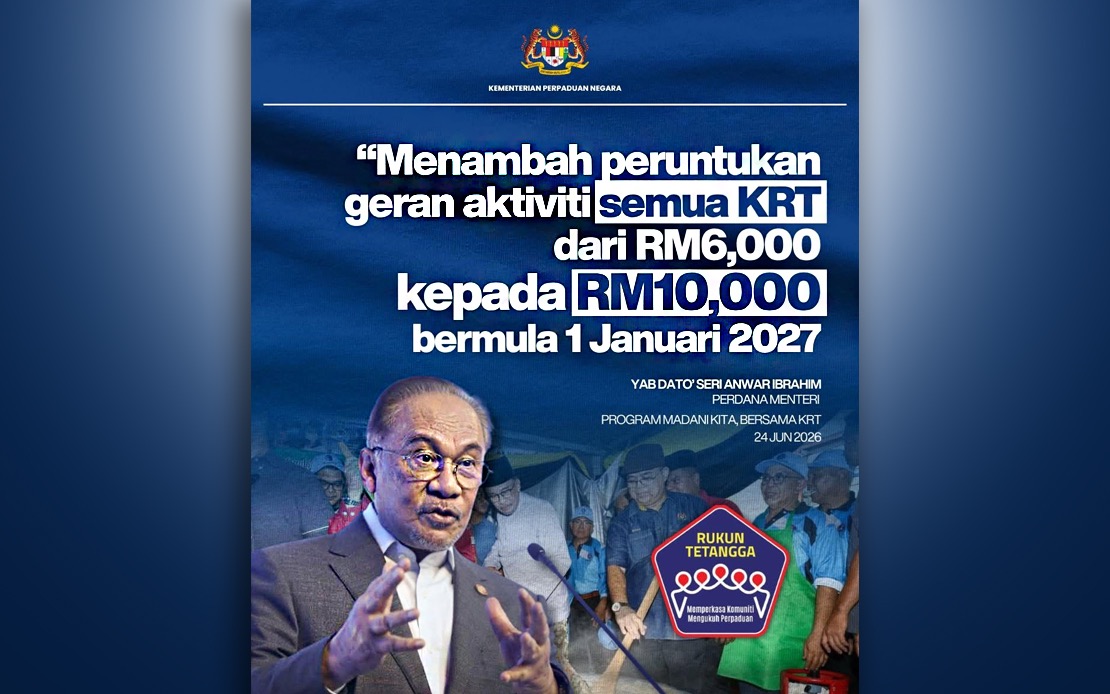
The Malaysian government has moved to substantially strengthen community policing and neighbourhood cohesion nationwide by doubling the annual operational grant for KRT (Kawasan Rukun Tetangga) groups from RM6,000 to RM10,000. Prime Minister Datuk Seri Anwar Ibrahim unveiled the decision during the MADANI KITA programme in Dataran Segamat, Johor, with the new funding stream commencing on January 1, 2027. This financial boost will directly affect all 8,615 registered neighbourhood watch areas across the country, marking a watershed moment for community-led security and social development initiatives at the grassroots level.
National Unity Minister Datuk Aaron Ago Dagang framed the increase as reflecting the federal administration's deep commitment to recognising KRT's contributions over more than five decades as a cornerstone institution promoting social harmony and national unity. The decision signals that policymakers view localised community structures not merely as auxiliary law enforcement mechanisms, but as essential platforms for building social capital and strengthening interpersonal bonds across diverse Malaysian communities. By directing substantially more resources toward these volunteer-led organisations, the government is effectively investing in its vision of unity through everyday neighbourhood engagement rather than top-down mandates.
The scale of KRT's existing impact provides important context for understanding why this funding increase matters. According to the minister's statement, approximately 250,000 KRT members currently operate within these neighbourhood watch areas, collectively reaching more than 12 million Malaysians through their activities. Over the past year alone, KRT groups orchestrated more than 100,000 community activities, demonstrating an impressive capacity for grassroots mobilisation. For Malaysian and Southeast Asian observers, these figures illustrate how decentralised community structures can achieve significant social reach without requiring massive central bureaucracies, a model potentially relevant for other nations in the region grappling with unity and social development challenges.
The anticipated use of the increased funding covers a broad spectrum of community priorities. Aaron outlined that the strengthened grants would enable KRT groups to expand and enhance programmes spanning unity initiatives, community development, welfare support, education, neighbourhood security, volunteerism initiatives, and local economic empowerment schemes. This comprehensive agenda reflects an understanding that neighbourhood cohesion requires multifaceted engagement rather than narrow focus on any single issue. By enabling KRT groups to address diverse local needs simultaneously, the funding increase effectively positions these organisations as holistic community development agents.
The timing and implementation of the funding increase reveal careful government planning. By deferring commencement to January 1, 2027, the administration allows time for budget planning and ensures smooth integration into the fiscal cycle. This measured approach contrasts with more abrupt policy implementations and suggests the government anticipates steady administrative absorption of the new arrangement across thousands of neighbourhood units. For KRT coordinators and members, this advance notice permits strategic planning around how to optimally deploy the additional RM4,000 annually per group.
Under the MADANI framework, this funding initiative forms part of a broader initiative to strengthen what government officials identify as the foundational bonds of Malaysian society. The minister's emphasis on neighbourliness as the cornerstone of national unity reflects a philosophy that macro-level national cohesion ultimately depends on micro-level community trust and regular interaction across ethnic, religious, and social lines. In Malaysia's diverse context, where neighbourhoods often represent the most immediate and intimate arena where citizens from different backgrounds interact regularly, strengthening KRT capacity directly supports this theoretical framework with concrete resources.
The government's positioning of this announcement within the broader MADANI campaign framework indicates that community empowerment has become a signature policy emphasis for the current administration. By publicly celebrating KRT's contributions and substantially increasing funding, Prime Minister Anwar Ibrahim sends a clear message about governmental priorities regarding grassroots institutions. This positioning may also reflect awareness that community-level organisations potentially offer more efficient and culturally sensitive pathways to addressing local concerns than centralised government service delivery alone.
For KRT members themselves, the funding increase presents both opportunity and responsibility. Groups will need to demonstrate effective stewardship of the additional resources to justify continued government support and maintain community confidence. The minister's statement emphasising that funding should be optimally utilised suggests the government expects clear accountability and measurable outcomes from the increased investment. KRT groups operating in different states and municipalities will face varying contextual challenges and opportunities, potentially requiring differentiated approaches to deploying the enhanced grants effectively.
The broader implications for Malaysian civil society merit consideration. By significantly investing in neighbourhood watch structures, the government signals confidence in community-level self-governance and volunteer mobilisation. This approach potentially models an alternative to purely market-driven or government-dominated approaches to social development and security. For other Southeast Asian nations observing Malaysian policy experiments, the KRT funding increase offers insights into how governments can operationalise community empowerment rhetoric with concrete fiscal commitments and sustained organisational support.
Regional observers and development specialists will watch closely how KRT groups utilise the increased funding and what measurable impacts emerge over the coming years. Success in implementing high-impact community programmes could strengthen the case for similar grassroots investment strategies across the region, while implementation challenges might reveal constraints in scaling volunteer-led initiatives. The Malaysian experience with doubling KRT grants thus carries significance extending well beyond the immediate beneficiary communities, potentially informing broader regional discussions about balancing centralised governance with grassroots empowerment.
The announcement also reflects acknowledgement that KRT members have historically operated under significant resource constraints. The previous RM6,000 annual grant, while meaningful, severely limited the scope and scale of programmes these volunteer-led groups could undertake. By more than doubling funding, the government removes a critical bottleneck that has constrained KRT's capacity to respond to community needs comprehensively. This recognition that adequate resourcing is essential to realising grassroots potential suggests a maturation of thinking around community development policy implementation.