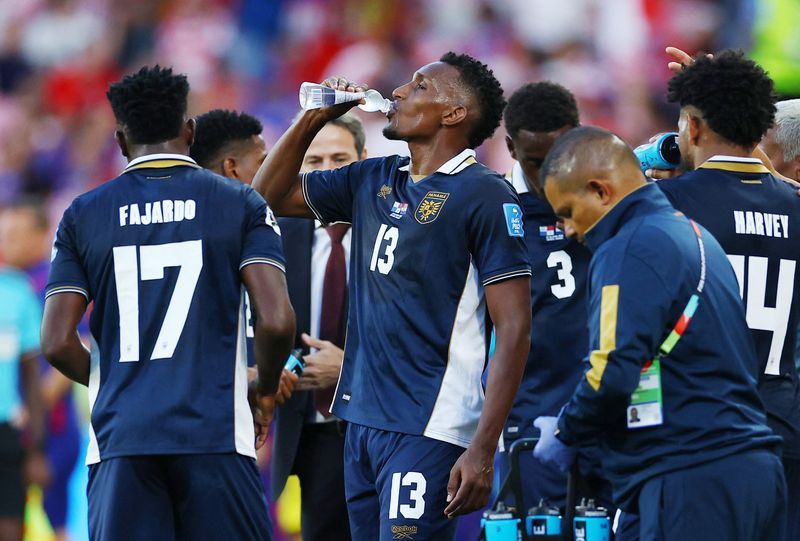
FIFA President Gianni Infantino has mounted a robust defence of the three-minute hydration breaks introduced at the World Cup, firmly rejecting suggestions that the stoppages are driven by profit motives. Speaking on Wednesday, Infantino clarified that the mandatory pauses—inserted at the 22nd and 67th minutes of every match—respond exclusively to player welfare considerations rather than generating additional revenue for football's governing body. The statement comes as the innovation has faced sustained criticism from prominent coaches, players, and match attendees questioning both its sporting merit and its true commercial purpose.
Since opening-round fixtures began, the hydration breaks have become one of the tournament's most contentious elements. Players and coaching staff have publicly expressed concern about how the stoppages fragment match rhythm, while broadcasters have eagerly filled these pauses with advertisement segments. The situation has sparked wider debate about whether FIFA genuinely prioritises athlete health or has simply found a convenient justification for inserting lucrative commercial windows into live matches. For Malaysian viewers and regional audiences accustomed to traditional, uninterrupted football experiences, the breaks represent a fundamental shift in how the sport is presented and consumed.
Infantino's central argument hinges on financial transparency. He emphasised that all broadcasting and commercial contracts were negotiated and finalised before the hydration breaks were implemented, meaning FIFA receives no incremental revenue from the additional advertising slots created by the stoppages. This claim, if accurate, distinguishes the breaks from explicit commercial manoeuvres designed to extract value. However, the distinction between direct FIFA revenue and broadcaster profits remains significant—while football's governing body may not directly benefit, broadcasters certainly do, raising questions about whose interests truly shaped the decision.
The primary justification offered is environmental and physiological. North American summer conditions present genuine challenges for player endurance and safety, particularly when teams face back-to-back matches across a compressed 39-day tournament schedule. Players may be required to compete in up to eight fixtures during this period, intensifying the cumulative physical toll. In this context, brief rest intervals become more than mere convenience; they represent a necessary safeguard against heat-related exhaustion and injury. This rationale particularly resonates in Southeast Asia, where tropical climates and indoor stadiums create their own performance variables that Malaysian audiences understand intimately.
Beyond physiological considerations, Infantino introduced a competitive equity argument that merits careful examination. He contended that without standardised breaks, teams benefiting from cooler venues or lower temperatures would lack opportunities for tactical reset and player recuperation that teams in sweltering conditions would receive. Such asymmetries could theoretically advantage certain nations based purely on environmental circumstance rather than sporting excellence. By implementing uniform breaks across all matches, FIFA aims to establish a level playing field where coaching acumen and player skill determine outcomes rather than climatic variations.
This argument has produced surprising support from some quarters. Spain coach Luis de la Fuente and Netherlands captain Virgil van Dijk have acknowledged the legitimate intentions behind the rule, though both cautioned against blanket application in cooler conditions or at climate-controlled venues where physiological justifications lose force. Their qualified endorsement suggests the concept enjoys broader acceptance when properly calibrated to actual environmental needs, rather than applied mechanically to every match regardless of circumstances.
Conversely, several prominent football figures remain unconvinced. England manager Thomas Tuchel has contended that the breaks fundamentally alter football's character by interrupting natural match flow and preventing the organic development of tactical situations. Uruguay coach Marcelo Bielsa articulated perhaps the more philosophical objection, arguing that shortening effective playing segments into discrete intervals strips away football's defining characteristic—its continuous, unfolding narrative tension. These criticisms extend beyond mere inconvenience to question whether modifying core match structure, ostensibly for health reasons, ultimately undermines the sport's essential nature.
Infantino addressed these concerns by asserting that match intensity has not diminished despite the breaks. According to FIFA's assessment, players maintain high performance levels throughout matches, suggesting the pauses do not create lethargy or performance collapse. This claim, while unverified by independent analysis, attempts to rebut arguments that the breaks fundamentally weaken competitive quality. However, differentiating between physical intensity and match momentum—the psychological flow that captivates audiences—represents a subtle but crucial distinction that FIFA's statement glosses over.
For Malaysian and Southeast Asian audiences, the hydration break debate carries additional resonance. Regional football development increasingly occurs in tropical environments where heat management represents a genuine technical consideration. Should FIFA's precedent gain traction, it could influence how domestic and regional competitions structure their own fixtures. Malaysian clubs competing in humid conditions might eventually adopt similar breaks, potentially reshaping fan expectations and broadcast formats across the region. Understanding whether these measures enhance player welfare or primarily serve commercial interests therefore carries implications extending far beyond the World Cup.
The controversy also reveals deeper tensions between football's traditional formats and modern commercial realities. Broadcasters require predictable content insertion points; players require adequate recovery during intense fixtures; and fans expect uninterrupted sporting spectacle. Reconciling these competing demands without compromising any party remains perpetually elusive. Infantino's defence rests on privileging player welfare while insisting financial interest played no role, yet the convenient alignment between sporting justification and commercial opportunity invites scepticism.
Moving forward, FIFA faces pressure to demonstrate that hydration breaks remain genuinely responsive to environmental conditions rather than becoming permanent tournament fixtures. Should the breaks become standard even at venues with climate control or in temperate weather, Infantino's credibility assertions would face significant challenge. The burden now rests on football's governing body to implement the measure with sufficient nuance and context-sensitivity to convince sceptics that sporting considerations truly drive the innovation rather than disguised commercial interests masquerading as player protection.