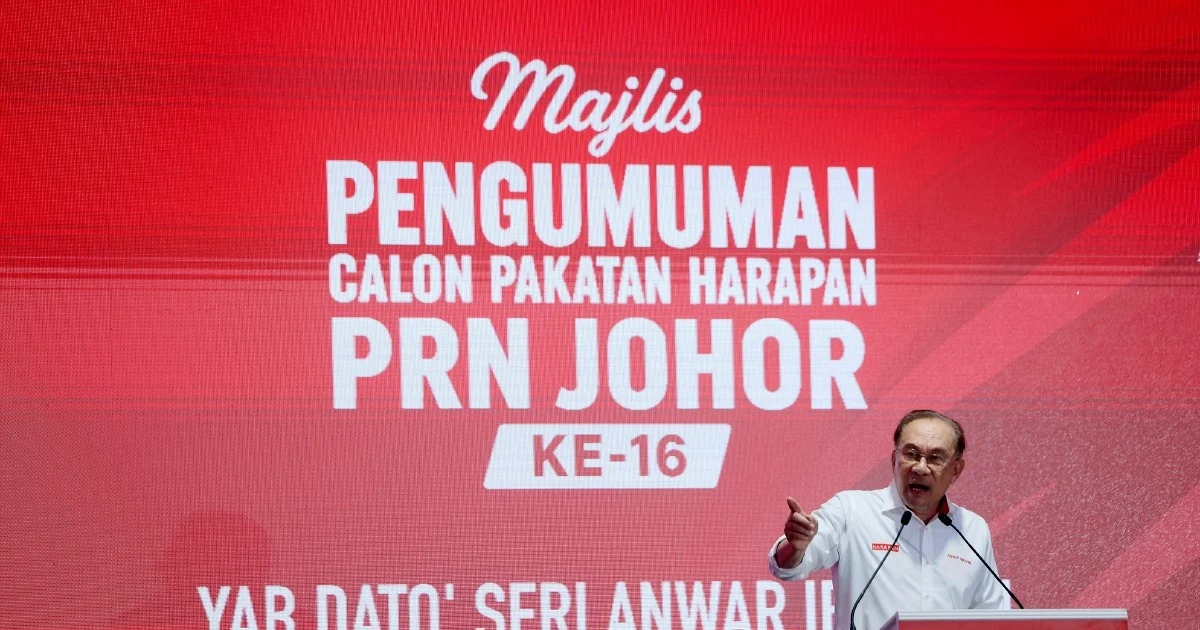
Prime Minister Datuk Seri Anwar Ibrahim has highlighted an asymmetry in Johor's relationship with the federal government that underscores Putrajaya's commitment to channelling resources to the southern state. Speaking in Tangkak, Anwar pointed out that over the past three years, Johor contributed RM14 billion in revenue to the federal coffers whilst receiving RM16 billion in allocations, representing a net injection of RM2 billion into the state's economy from the national budget.
This financial dynamic reflects a broader policy framework where the federal government utilises its revenue-raising capabilities to support state-level development initiatives. Johor, as Malaysia's second-largest state by economic output and a significant contributor to the national economy, has historically played a crucial role in generating federal revenue. The fact that the state received more than it contributed during this three-year period suggests a deliberate rebalancing in federal spending priorities, potentially aimed at addressing infrastructure gaps or strategic development goals that require capital investment.
The disclosure carries particular significance given ongoing discussions about fiscal federalism in Malaysia and how equitably the federal system distributes national resources. Johor's experience illustrates that allocation formulas are not strictly revenue-based; instead, the federal government factors in developmental needs, regional economic strategies, and political considerations when deciding where to direct funds. This approach means poorer-performing or underdeveloped states can receive proportionally higher investments to address their growth constraints.
For Malaysian readers, understanding these fiscal flows is essential to comprehending how the country's devolved system of governance actually functions in practice. Many Malaysians assume that wealthy states that generate high tax revenues receive the largest federal allocations, but the reality is far more nuanced. The federal government maintains discretion over how it deploys resources beyond basic revenue-sharing formulas, allowing it to invest in strategic priorities across the federation regardless of a state's immediate contribution capacity.
Johor's position as an economic powerhouse extends beyond agriculture and manufacturing into petrochemicals, refining, and increasingly, services and technology sectors. The state is home to the Port of Tanjung Pelepas, one of Southeast Asia's busiest container terminals, and its strategic location near Singapore makes it a critical economic corridor. Federal investments in Johor thus carry multiplier effects that benefit the entire national economy, justifying a spending approach that may temporarily exceed the state's direct tax contributions.
Anwar's public articulation of these figures serves a communicative purpose beyond mere economic reportage. By demonstrating that Johor receives more federal funding than it contributes, the Prime Minister addresses potential concerns about whether the state receives its fair share of national resources. This transparency can build confidence among Johor residents and business leaders that the federal government treats the state equitably, particularly important in a state that wields considerable political influence in Malaysian politics.
The three-year timeframe cited by Anwar also matters for context. Depending on which period is referenced, this interval could encompass pandemic recovery spending, post-election allocations, or targeted infrastructure initiatives. The RM16 billion received might include capital expenditures on highways, ports, educational institutions, healthcare facilities, and administrative infrastructure, many of which deliver long-term benefits extending far beyond the three-year measurement window.
For Southeast Asia's broader perspective, Malaysia's approach to inter-governmental fiscal transfers demonstrates how federal systems can actively use redistribution mechanisms to promote balanced development. Unlike some neighbouring countries where revenue generation directly determines state resources, Malaysia's model allows for corrective investments that prevent excessive economic concentration. This flexibility has helped maintain cohesion across states with vastly different economic capacities and demographics.
The federal government's willingness to allocate more to Johor than the state generates in taxes also reflects confidence in Johor's development trajectory and growth potential. When governments invest more in a region than that region immediately produces in revenue, they are essentially betting on future returns. Improved infrastructure, better-educated workforces, and modern facilities in Johor are expected to generate enhanced economic activity and tax collection in subsequent years, justifying the upfront investment.
Investors monitoring Malaysian federal-state relations will likely view Anwar's statement favourably, interpreting it as a signal that Johor remains a priority in national development planning. Multinational corporations and domestic businesses considering expansion into Johor can take such commitments as indication that the state will continue receiving substantial infrastructure investment and government support, reducing perceived investment risk in the region.
Moving forward, the fiscal relationship between Johor and the federal government will continue evolving based on economic performance, demographic changes, and shifting national development priorities. The three-year figures Anwar cited establish a baseline for assessing whether this pattern of federal investment in Johor persists, and whether other states begin requesting similar transparent accounting of their fiscal relationships with Putrajaya.