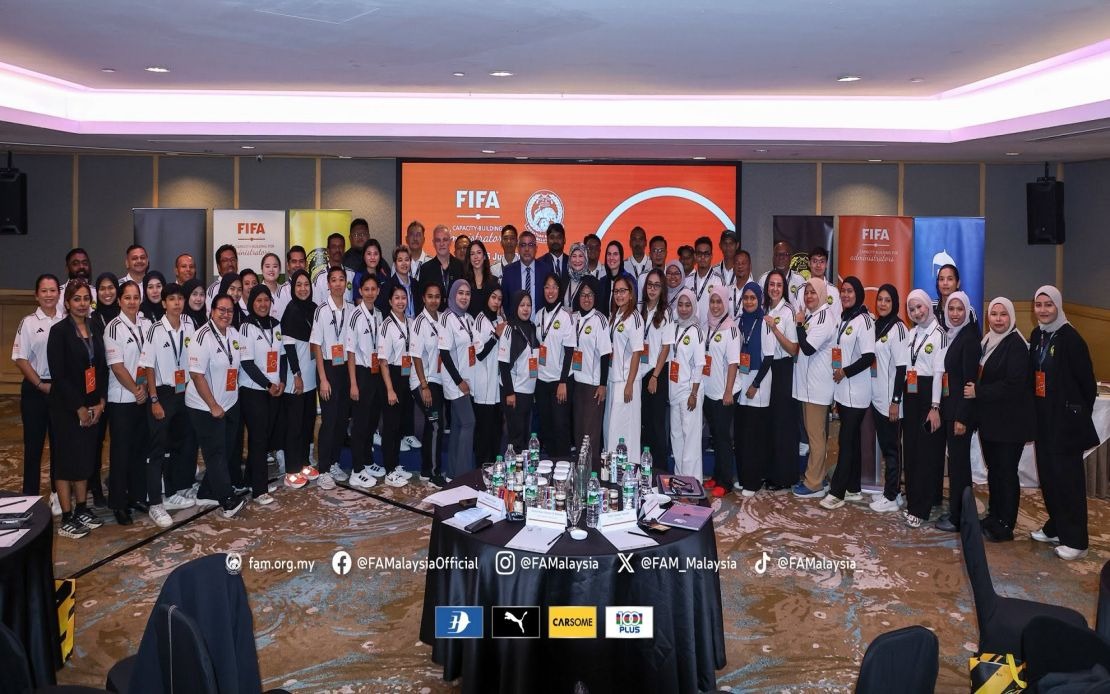
The Football Association of Malaysia has embarked on an ambitious initiative to fortify the institutional scaffolding underpinning women's football development through a specialised FIFA Capacity-Building For Administrators 2026 programme that commenced on June 23 in Kuala Lumpur. The four-day workshop represents a deliberate pivot toward comprehensive ecosystem development, signalling FAM's recognition that sustained growth in the sport demands equal investment in off-field infrastructure alongside technical on-field improvements.
The programme distinguishes itself by drawing expertise from FIFA's specialist Women's Football Development team, with facilitators Safia Abdeldayem and Pema Choden Tshering delivering modules across critical governance domains. Participants—comprising team managers, administrative officers, and aspiring leaders within Malaysian women's football—will engage with curricula spanning Women's Leadership, Women's Competition structures, Club and Players' Rights frameworks, and Strategic Planning methodologies. This curriculum architecture reflects international best practices in sports administration, adapted for the Malaysian and Southeast Asian context where institutional maturity in women's football governance remains an evolving frontier.
The leadership demonstration at the programme's launch underscored FAM's institutional commitment to this initiative. Datuk Noor Azman Rahman, FAM's secretary-general, alongside Datuk Suraya Yaacob—who holds positions within both FIFA's Women's National Team Competitions Committee and the Asian Football Confederation's Women's Football Committee—and FAM Women's Football Technical Director Soleen Al-Zoubi, conveyed the federation's determination to embed administrative excellence across the women's game. Such high-level attendance signals to stakeholders that capacity-building in administrative functions carries strategic importance comparable to grassroots development and elite player progression.
FAM's positioning of this programme reflects a maturing understanding of women's football development dynamics. Throughout the region and globally, investment in women's football has historically concentrated on talent identification, coaching certification, and competition structure, often leaving administrative and management functions under-resourced. By explicitly addressing the management and administrative dimension, FAM acknowledges that professionalisation at all levels—including those managing day-to-day operations, player welfare, financial systems, and organisational governance—constitutes foundational infrastructure for sustainable sport development.
The Women's Leadership module carries particular significance for Malaysian women's football. Across Southeast Asia, female representation in football administration and management hierarchies remains disproportionately low relative to participation growth. By frontloading leadership development within the programme, FAM creates pathways for Malaysian women to occupy decision-making roles in club management, federation structures, and competition administration. This approach aligns with FIFA's global strategic emphasis on increasing women's representation across all football governance levels, a prerequisite for ensuring women's football addresses its own developmental needs rather than operating within frameworks designed for men's football.
The Women's Competition module addresses structural complexity that extends beyond individual clubs. Malaysia's women's football ecosystem encompasses multiple tiers—the national league, cup competitions, youth tournaments, and international fixtures—each requiring distinct administrative approaches. Administrators trained in competition management gain practical knowledge of fixture scheduling, regulatory compliance, referee management, and fan engagement specific to women's competitions. These competencies directly influence match-day experiences, player development pathways, and the commercial viability of women's football within the Malaysian market.
Club and Players' Rights instruction represents a critical protective mechanism. Malaysian football's growth has occasionally outpaced governance maturity, with disputes over player contracts, welfare provisions, and employment conditions occasionally escalating into conflicts that damage institutional credibility. By establishing common understanding of best practices in player rights protection, club governance, and dispute resolution mechanisms, the programme strengthens the ecosystem's resilience. Players benefit from administrators equipped to implement professional standards; clubs benefit from clearer operational frameworks; the federation benefits from reduced governance friction.
Strategic Planning components address longer-term institutional development. Malaysian women's football clubs and administrative bodies increasingly navigate complex environments involving stakeholder management, financial planning, government relations, and community engagement. Strategic planning expertise enables managers to develop coherent multi-year visions, align resources with objectives, and navigate external pressures systematically rather than reactively. This capacity is particularly valuable as women's football competes for sponsorship, media attention, and venue access within increasingly competitive Malaysian sports markets.
FAM's emphasis on creating a "stronger, more professional and sustainable ecosystem" acknowledges that women's football development constitutes a multi-decade enterprise. Short-term competitive success, while valuable, cannot substitute for institutional development that outlasts individual players or leaders. By cultivating a cadre of skilled administrators, FAM invests in continuity and knowledge retention. Malaysian women's football becomes less dependent on individual charismatic figures and more grounded in robust institutional practices.
The collaboration with FIFA amplifies this programme's credibility and technical quality. FIFA's role as global football's institutional apex means FIFA-developed curricula reflect international best practices and evolving governance standards. Malaysian administrators trained through FIFA frameworks gain competencies recognised across continental and global structures, facilitating knowledge exchange with regional peers and creating opportunities for future engagement with FIFA's broader capacity-building ecosystem. This international dimension helps Malaysian women's football align with global standards, potentially attracting investment and partnerships that value professional administration.
For Malaysian women's football participants specifically, the programme timing proves strategically opportune. As the national league structure matures and investment in women's football increases, administrative capacity becomes the limiting factor in further development. Clubs with professionally managed operations attract better sponsorships, develop stronger player retention, and create competitive advantages. Federations with sophisticated administrators navigate international competitions more effectively and manage relationships with government stakeholders more strategically. This programme addresses exactly this bottleneck.
Regional implications extend across Southeast Asia's women's football landscape. Malaysia's approach influences peer federations across ASEAN, particularly within the AFC development ecosystem. By demonstrating serious institutional investment in administrative capacity-building, FAM establishes a benchmark that may influence regional standards and expectations. The programme's success or failure will likely influence how other Southeast Asian football associations approach women's football development strategy, particularly regarding the relative weighting of on-field versus administrative development investments.
Looking forward, the real test of this programme's success will manifest not immediately but across the next 2-3 years, as trained administrators implement new practices within their respective organisations. The sustainability question—whether FAM systematically institutionalises the knowledge and practices taught through one-off capacity-building sessions—remains critical. If the programme functions as a catalyst for sustained institutional change rather than an isolated training event, Malaysian women's football gains meaningful competitive advantage within the regional landscape.