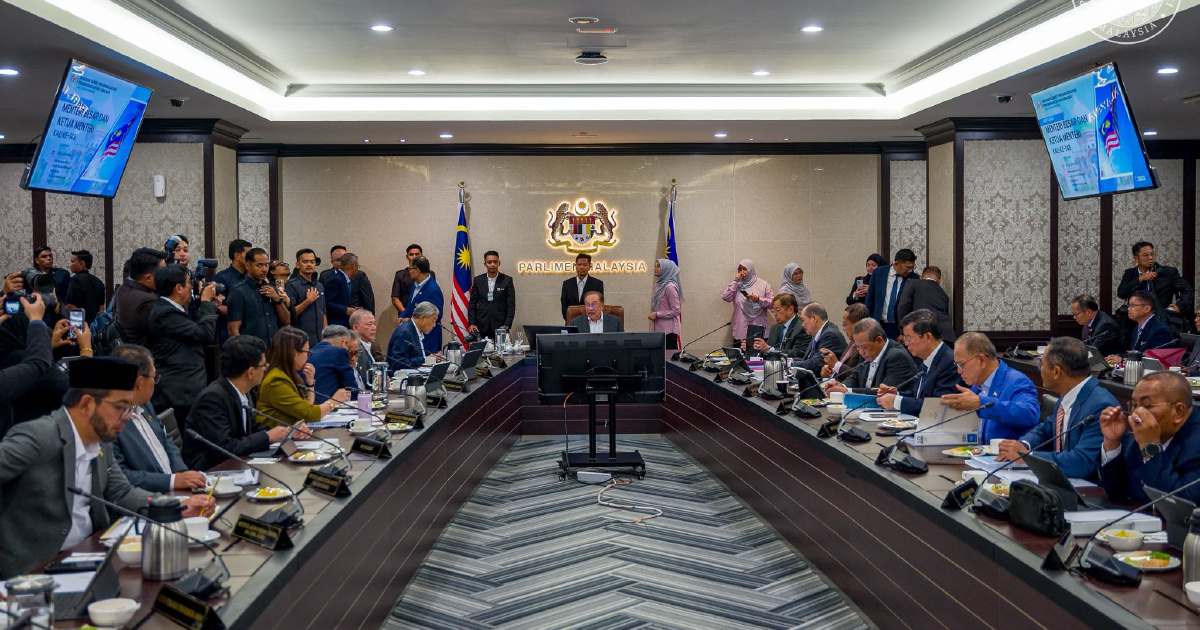
Prime Minister Datuk Seri Anwar Ibrahim convened the 149th national gathering of Menteris Besar and Chief Ministers at Parliament House in Kuala Lumpur, with revitalising Malaysia's struggling economy emerging as the dominant theme. The high-level meeting brought together the country's state leaders to chart coordinated policy responses to mounting economic headwinds, particularly those stemming from escalating geopolitical tensions in the Middle East that threaten regional stability and trade flows.
The gathering underscored growing recognition within Malaysia's political establishment that economic revival cannot be achieved through federal action alone. With states controlling significant levers—including land development, infrastructure, investment attraction, and commerce—cohesion between the national and state governments proves essential for executing any comprehensive recovery programme. By bringing all regional leaders into a single forum, Prime Minister Anwar signalled commitment to forging a unified economic strategy that transcends the traditional federal-state divisions that often complicate governance.
International volatility presents a particularly acute challenge for a nation whose economy depends heavily on trade and investment. The ongoing Middle East conflicts have created unpredictable energy markets, disrupted shipping lanes critical to Malaysian commerce, and injected uncertainty into the calculations of foreign investors considering regional expansion. These external pressures arrive at a moment when Malaysia's domestic growth momentum has already softened, making coordinated crisis management between government tiers more urgent than routine.
The states occupy a frontline position in responding to economic slowdown. Consumer spending, unemployment, and investment activity register most immediately at the local level, where state governments can implement targeted interventions in their jurisdictions. By assembling Menteris Besar and Chief Ministers, Prime Minister Anwar created space for subnational leaders to air regional economic concerns and propose place-based solutions rather than accepting one-size-fits-all federal directives. This consultative approach reflects growing sophistication in Malaysian governance, acknowledging that economic recovery strategies must account for the vastly different economic structures, development stages, and vulnerabilities across Malaysia's thirteen states and three federal territories.
The timing of the 149th meeting carries additional significance given Malaysia's broader economic trajectory. Recent months have witnessed softening growth forecasts, labour market pressures, and rising cost-of-living concerns among ordinary Malaysians. Agricultural states face distinct challenges from industrial or tourism-dependent regions. Sarawak and Sabah, with their substantial natural resources, encounter different market dynamics than Selangor or Penang. A meeting designed to exchange perspectives on these varied circumstances allows policymakers to design recovery initiatives with greater geographic nuance than centralised planning permits.
The Middle East context merits particular attention for Southeast Asian observers. Malaysia maintains substantial economic ties with Gulf states through investment, trade, and labour migration. Regional conflict escalation threatens these relationships and introduces volatility into oil and gas pricing—sectors Malaysia remains sensitive to despite economic diversification efforts. Beyond energy, geopolitical instability in the Middle East typically triggers global risk reassessment, dampening investor appetite for emerging market opportunities and potentially redirecting capital flows away from Southeast Asia toward perceived safer havens. For Malaysia specifically, any contraction in Gulf investment or demand for Malaysian exports would reverberate through employment and government revenues.
The summit's focus on economic revival rather than crisis management suggests a measured rather than panicked official response. Malaysian authorities appear to be treating current challenges as manageable headwinds requiring coordinated response, not existential threats demanding emergency measures. This framing allows space for constructive dialogue about medium-term strategic repositioning rather than reactive firefighting. It also reflects confidence that Malaysia's diversified economy, while challenged, possesses resilience to weather current uncertainties if government at all levels coordinates effectively.
State leaders attending the parliament meeting bring crucial ground-level intelligence about economic conditions within their jurisdictions. Governors of manufacturing-dependent states can report on factory activity and export order trends; leaders of tourism destinations can discuss visitor arrival patterns and sector health; officials from agricultural regions can address commodity price pressures and farmer welfare. This bottom-up intelligence feeds federal policymakers with current reality on the ground, permitting responsive rather than reactive decision-making. Prime Minister Anwar, as chair, positioned himself to synthesise these diverse perspectives into coherent national strategy.
The 149th meeting framework also facilitates cooperation on specific sectoral initiatives. States can coordinate with federal authorities on export promotion campaigns, industrial park development, infrastructure projects, and investment roadshows targeting specific markets or investors. Regional collaborations—such as Klang Valley coordination between Selangor and Kuala Lumpur, or northern region cooperation between Penang, Kedah, and Perlis—strengthen when state leaders meet collectively and federal ministers attend to provide support and remove bureaucratic obstacles.
Looking ahead, the effectiveness of the 149th meeting will be measured not by rhetoric but by implementation. Whether state governments subsequently coordinate labour market policies, infrastructure spending, and investment incentives—rather than competing against each other—will determine whether the gathering generated meaningful action or remained an exercise in symbolic consensus-building. The real test arrives when individual states must balance federal directives against local political and economic interests, a tension that has historically complicated Malaysian governance.
The larger significance of assembling all state leaders reflects institutional maturation. Malaysia's federal system, traditionally characterized by centre-periphery tensions, increasingly recognises that complex policy challenges demand multilevel governance architecture where state and national authorities work as partners rather than competitors. Economic revival during geopolitical uncertainty exemplifies precisely the type of challenge requiring such coordinated response. How effectively Prime Minister Anwar and the assembled governors translate their parliamentary meeting into synchronized action across states will substantially influence Malaysia's capacity to navigate current economic turbulence and maintain competitive positioning within Southeast Asia.