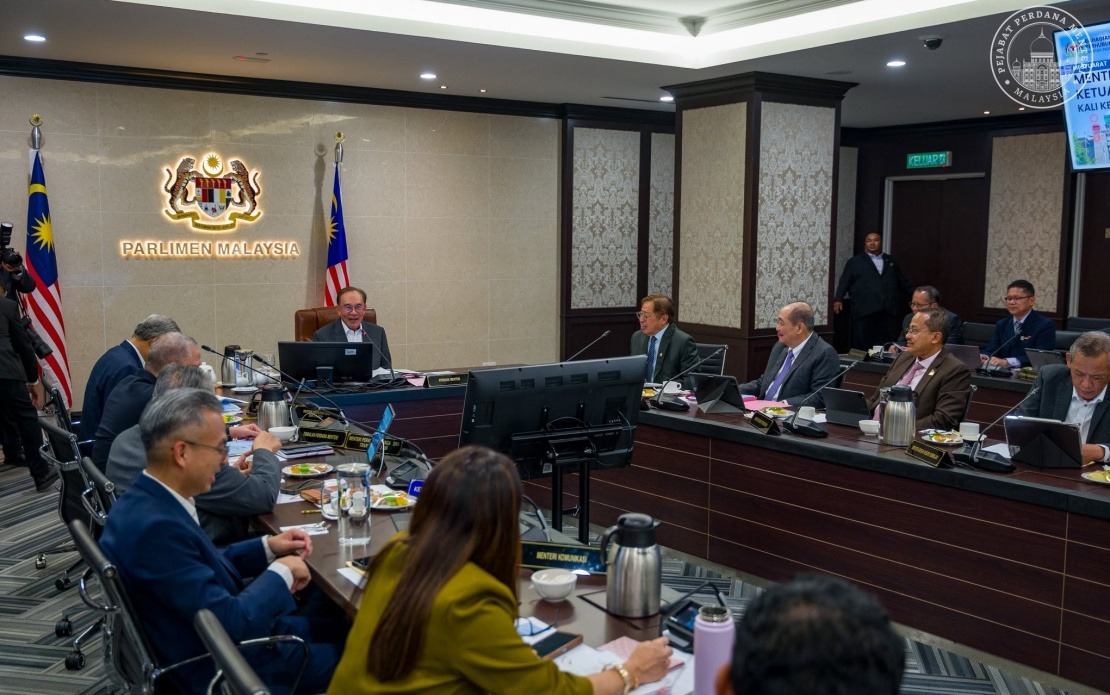
Prime Minister Datuk Seri Anwar Ibrahim presided over the 149th Meeting of Menteris Besar and Chief Ministers at the Parliament Building today, directing federal and state leadership to prioritise economic stabilisation as external shocks continue to reverberate through Malaysian markets. The gathering brought together state executives responsible for implementing crucial development programmes, signalling the government's intent to align subnational policy-making with broader federal economic objectives at a time when regional and global pressures threaten growth trajectories.
The centrepiece of discussions centred on marshalling resources and coordinating strategies to fortify Malaysia's economic foundations despite intensifying geopolitical turbulence. Anwar specifically highlighted the destabilising effects of ongoing conflicts in West Asia, which have created unpredictable commodity price fluctuations, disrupted shipping corridors, and clouded investor confidence across Southeast Asia. For a trade-dependent economy like Malaysia, such external volatility demands synchronized responses between federal policymakers and state governments that must implement ground-level initiatives affecting employment, agricultural production, and consumer spending.
Beyond immediate economic concerns, the meeting devoted substantial attention to environmental and climate resilience. Anwar underscored escalating preparedness measures needed to confront the El Niño phenomenon, an atmospheric pattern expected to trigger severe water scarcity across several regions, fundamentally threaten agricultural productivity during critical growing seasons, and exacerbate food security vulnerabilities. The implications extend beyond temporary hardship; prolonged drought conditions could undermine rural livelihoods, force agricultural communities into debt cycles, and concentrate food supply dependencies on imports—outcomes that reverberate through consumer prices and inflation dynamics affecting ordinary Malaysians.
The Prime Minister stressed that addressing these converging challenges requires systematic integration of federal and state initiatives, moving beyond siloed departmental approaches that historically fragmented Malaysia's governance response to crises. This emphasis on coordination reflects a recognition that economic revival cannot succeed through centralised decree alone; state governments controlling land, local infrastructure, and community engagement must become active partners in execution rather than passive administrators of federal directives. Such an approach potentially unlocks efficiencies when policies developed in Putrajaya encounter local implementation realities that officials in the capital cannot fully anticipate.
A critical dimension of the meeting involved restructuring how development benefits distribute across Malaysia's population. Anwar articulated a commitment to ensuring that policy outcomes genuinely reach ordinary citizens rather than concentrating gains among urban centres or connected business interests. This people-centric framing suggests awareness that economic statistics alone—regardless of impressive GDP growth rates—fail to gain political traction if households experience stagnant wages, deteriorating services, or limited advancement opportunities. For state leaders grappling with constituents demanding tangible improvements, this message implicitly endorses directing resources toward mechanisms that strengthen purchasing power and livelihood security among lower and middle-income communities.
The meeting's focus on attracting quality investments alongside economic competitiveness reveals assumptions about Malaysia's competitive positioning in a shifting regional landscape. As Vietnam, Thailand, and Indonesia compete aggressively for manufacturing relocations and technology sector establishments, Malaysian officials recognise that competing primarily on cost—a strategy that enriched the nation decades ago—no longer suffices. Cultivating higher-value industries requires educational ecosystems, reliable infrastructure, and regulatory environments where state governments play irreplaceable roles, explaining why their engagement in investment attraction strategies matters substantially.
Anwar's invocation of federal-state cooperation and consensus-building carries particular significance given Malaysia's constitutional architecture, which distributes authority between centre and periphery across numerous policy domains. When federal leadership explicitly celebrates collaborative decision-making and unified direction, it signals either genuine partnerships or aspirational framing intended to mobilise state administrations toward federal priorities. Either interpretation reflects recognition that Malaysia's capacity to navigate concurrent economic, environmental, and geopolitical challenges hinges on reducing the friction that historically characterised centre-state relations, where competing interests, resource competition, and differing political affiliations sometimes impeded coordinated responses.
The timing of this convening—amid West Asian instability that threatens global commerce—underscores Malaysia's vulnerability as a small open economy lacking control over decisive external factors. While policymakers can implement competent domestic management, commodity price shocks, currency fluctuations, or disrupted trade routes imposed by distant conflicts remain beyond Malaysian influence. This reality frames the meeting's emphasis on integrated preparedness not as a technical exercise but as a pragmatic acknowledgment that resilience requires rapid information-sharing between federal and state authorities, flexible resource allocation mechanisms, and pre-positioned contingency responses that activate quickly when crises materialise.
The consensus expressed at the meeting reflects broader expectations that Malaysia's political class, despite fractious coalition politics and competing party interests, recognises shared stakes in economic stability. State governments led by opposition parties depend on economic growth to legitimise their administrations and satisfy constituents, aligning incentives with federal recovery efforts even absent partisan alignment. This partial convergence of interests creates space for genuine cooperation, though translating agreement at ministerial level into effective implementation across thousands of local government units, agencies, and private sector partners requires sustained commitment beyond the meeting hall.
Moving forward, the 149th meeting's outcomes will face practical tests as state administrations incorporate federal directives into budgetary decisions, infrastructure projects, and regulatory choices. Success requires not merely rhetorical commitment to people-centric policymaking and economic revival but sustained resource allocation, institutional capacity-building, and willingness among federal and state officials to genuinely collaborate rather than compete for credit or blame depending on outcomes. For Malaysian observers and regional counterparts monitoring governance quality, implementation of this meeting's principles will reveal whether Malaysian federalism has matured toward functional partnership or remained characterised by structural tensions constraining policy effectiveness.