Dutch Prime Minister Rob Jetten delivered a formal state apology on Sunday to members of the Moluccan community, acknowledging the Netherlands' historical mistreatment of people from Indonesia's spice islands who were transported to the country following the nation's independence struggle. The apology, delivered during an official ceremony in Rotterdam, represents a significant moment of reckoning for one of Western Europe's most consequential colonial legacies in Southeast Asia, and carries resonance for regional audiences grappling with similar historical justice questions.
The Moluccas, situated in eastern Indonesia, held particular strategic and economic importance during the Dutch colonial period. Many inhabitants of these islands developed deep ties to the Dutch colonial administration, with significant numbers serving in the Dutch colonial military forces. This loyalty would prove catastrophic following World War II, when Indonesian nationalists pressed for independence from Dutch rule. When the struggle intensified, those Moluccans who had fought alongside the Dutch faced a profound dilemma: remaining in Indonesia risked severe retribution from independence forces, while the Dutch offered what appeared to be a temporary refuge.
Between 1951 and 1952, approximately 12,500 Moluccans were transported to the Netherlands in what Dutch authorities presented as a temporary evacuation arrangement. The Dutch government and Indonesian negotiators had ostensibly agreed that these evacuees would return home once an independent Indonesia was established and political stability returned. This understanding became the cornerstone of what the Moluccan community believed was a binding commitment. However, the Dutch government never fulfilled this promise, and the temporary stay became a permanent exile that would span decades and profoundly shape the lives of multiple generations.
The conditions awaiting Moluccans in the Netherlands bore little resemblance to the welcoming reception one might expect for war allies. Rather than integration into Dutch society or preparation for eventual repatriation, many were housed in deliberately segregated facilities and former wartime concentration camps that had been used to detain Jews during the Nazi occupation. This choice of accommodation was particularly symbolic and distressing, confining people who had fought for the Dutch to spaces marked by Europe's darkest Holocaust memories. Employment opportunities were scarce, education support minimal, and deliberate efforts at social integration were largely absent.
The Moluccan community found themselves trapped in legal and social limbo. They were neither accepted as integral members of Dutch society nor permitted to return to their homeland. Employment discrimination was common, housing remained substandard, and the psychological toll of indefinite displacement weighed heavily on both first-generation arrivals and their Dutch-born children. The community's narrative of sacrifice and service to the Dutch crown appeared to count for little in postwar Dutch politics, where Indonesia was increasingly treated as a sovereign nation with whom the Netherlands sought to maintain diplomatic relations.
The frustration and sense of betrayal intensified dramatically during the 1970s, when second-generation Moluccans, many born in the Netherlands and having no direct memory of their homeland, began to rebel against their marginalized status. Feeling both rejected by the Dutch society in which they were raised and disconnected from the Indonesia their parents had fled, these young people engaged in a series of violent actions including train hijackings and hostage-takings. These incidents shocked Dutch society but also represented a desperate attempt by a community to assert its existence and voice legitimate grievances that had been ignored for two decades.
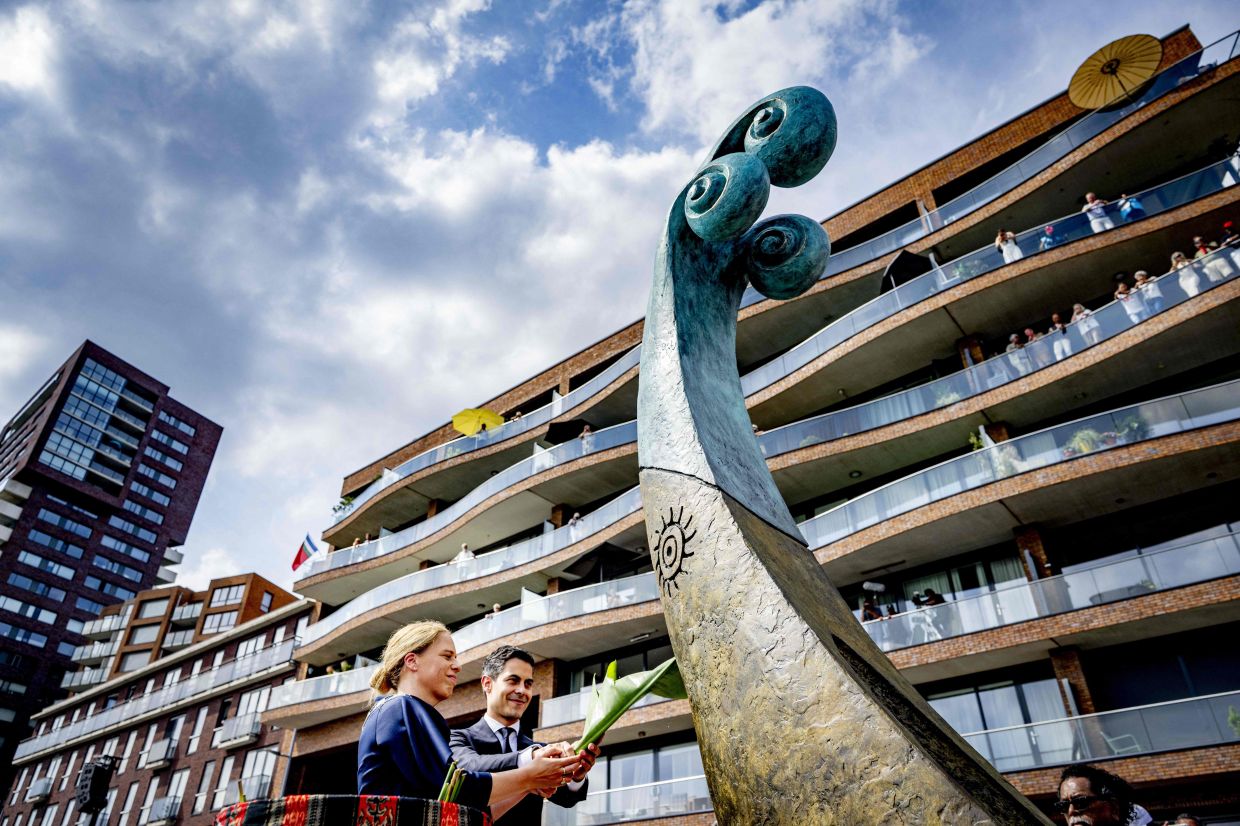
The unveiling of the Ulu Kora monument in Rotterdam, at the Lloydkade where the first Moluccan transport ships arrived, provided the physical and symbolic setting for Prime Minister Jetten's formal apology. Addressing hundreds of Moluccans gathered for the ceremony, many visibly moved and holding photographs of deceased relatives, Jetten acknowledged specific dimensions of the injustice. He apologized for the inadequate reception and housing conditions, for the community's invisibility in Dutch public discourse, for the abandonment of the repatriation promise, and for the accumulated grief and familial suffering across generations.
Jetten's language revealed awareness of the apology's limitations. He explicitly stated that words alone cannot reverse history or undo decades of injustice, nor can an apology suddenly erase the lived reality of displacement and marginalization. Yet he framed the moment as an essential act of recognition and what he termed "historical justice," suggesting that formal acknowledgement by the state—even decades later—carries intrinsic value beyond material compensation. This formulation reflects evolving Western approaches to historical redress, where official recognition is often positioned as a prerequisite for healing even when tangible restitution remains contested or limited.
For Malaysian and Southeast Asian readers, this moment resonates with broader regional conversations about colonial legacies and post-independence justice. Many nations in the region have grappled with questions about how to address historical wrongs committed by colonial powers, and how successor states should reckon with the consequences of colonialism. The Moluccan case illustrates how colonial relationships created vulnerable populations whose suffering persisted long after formal independence, and how geopolitical interests often trumped moral obligations to displaced communities.
The apology also underscores the importance of institutional memory and intergenerational advocacy. The Moluccan community maintained its claims to justice across fifty years, despite political marginalisation and social invisibility. This persistence ultimately created conditions where the Dutch state found continued resistance to historical reckoning untenable. The parallel with other postcolonial communities throughout Southeast Asia is evident: formal recognition, while not resolving all historical grievances, represents an essential step toward societal acknowledgement of shared responsibility for colonial consequences.
The monument itself functions as more than decorative commemoration. It physically marks Rotterdam's landscape with evidence of a historical episode many Dutch citizens had long forgotten or minimized. The Lloydkade location is particularly significant, connecting the monument directly to the moment when Moluccans first arrived in the Netherlands, anchoring abstract historical concepts in specific geography and embodied experience. Future generations visiting Rotterdam will encounter material evidence of this history, potentially shifting how the city's relationship to colonialism and postcolonial responsibility is understood.
The Moluccan experience also illustrates how colonial legacies create enduring transnational communities whose identities and claims span multiple nation-states. These communities often lack the political power to advance their interests effectively, making sustained advocacy and external pressure necessary preconditions for state acknowledgement. The trajectory from violent protest in the 1970s to formal apology in 2024 suggests that such recognition, while arriving late, may still be achievable for communities willing to maintain their claims across generations.