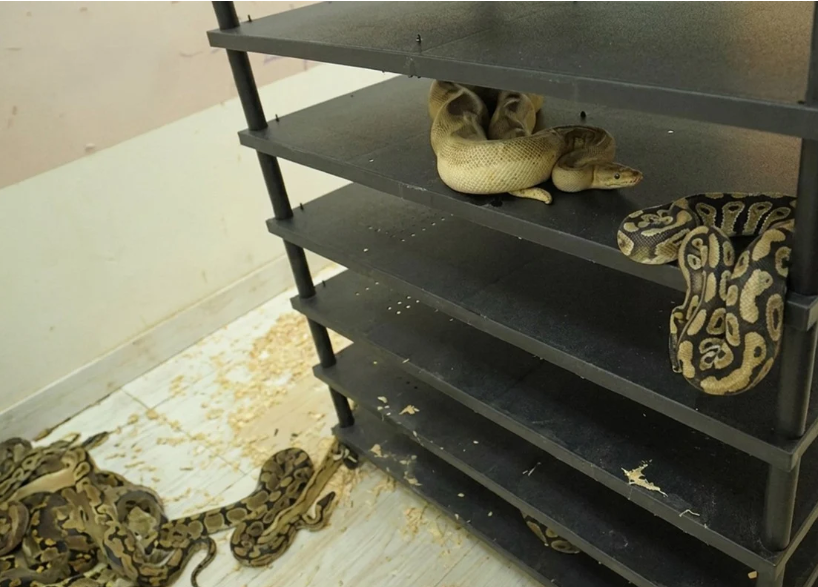
A residential flat in Taizhou, Zhejiang province became the unlikely epicentre of one of China's more unusual wildlife enforcement cases when police uncovered an illegal breeding operation housing more than 300 pythons. The discovery resulted in prison sentences for a man named Guo and his associates, exposing how sophisticated illegal wildlife trafficking networks can operate behind closed doors in ordinary urban apartment complexes. The case, highlighted by state broadcaster CCTV in late June, represents what authorities described as a "serious" violation of protections for rare and endangered species.
The investigation began innocuously when an elderly resident discovered a stray python at the base of a local mountain in March 2024 and reported it to authorities. The tawny reptile, reportedly as thick as an adult's arm, seemed entirely out of place in the region where such snakes do not naturally occur. Police reasoned that the animal had likely escaped captivity, particularly given that wild snakes typically remain dormant during March in temperate zones. This initial discovery proved crucial in unravelling a criminal operation that had operated undetected for years.
The breakthrough came through an unconventional investigative approach. Police consulted a professional snake breeder who explained that pythons require carefully controlled warm and humid conditions to thrive, typically maintained between 20 and 30 degrees Celsius. This expert insight led officers to a simple but effective strategy: they examined electricity consumption patterns across the neighbourhood, identifying households with unusually high usage that might indicate climate-controlled breeding facilities. This methodical screening process eventually zeroed in on Guo as a prime suspect.
Guo's profile fitted certain criteria that made him stand out. The man lived alone, remained unmarried, and listed no formal employment on official records. His unremarkable appearance masked an extraordinary obsession with serpents. Officers who conducted surveillance noticed that another individual, identified as Di, made frequent visits to Guo's flat, regularly collecting parcels from courier stations. These packages contained live white mice purchased online, commodities typically associated with reptile feeding rather than domestic consumption.
Online vendors cooperated with the investigation, confirming that the mice had been ordered in quantities consistent with sustaining a large reptile collection. Digital footprints proved equally damning. Guo had shared photographs of snakes across social media platforms and made veiled references to selling his breeding stock to interested buyers. Investigators uncovered transaction records documenting that Di had sold two pythons to another individual for 1,000 yuan, approximately US$150, indicating that the operation extended beyond private breeding into commercial sales.
The arrest phase produced a dramatic revelation. When officers arrived at Guo's flat with a search warrant, they were stunned by the extent of the operation. Plastic storage boxes containing pythons were stacked throughout the residence, creating a labyrinth of reptile housing. Guo had crammed his personal possessions into a single bedroom, dedicating the remaining two bedrooms and the entire living room to snake accommodation. Officers ultimately counted 309 pythons seized from the property, which were subsequently transferred to a local zoo for care and assessment.
Guo's interrogation revealed the depth of his commitment to his illegal enterprise. He explained that his fascination with snakes extended back a decade, beginning in 2014 when he purchased his first four pythons. Since then, his activities had evolved from simple ownership into systematic breeding research. In a telling statement, Guo expressed pride in his work, saying "I am capable of cultivating snakes of various colours. I feel like a creature creator." This perspective demonstrated how an individual's hobbyist interest had metastasised into a large-scale operation that flouted China's strict wildlife protection regulations.
The investigation revealed that Guo operated not in isolation but as part of a small criminal network. Di's involvement extended beyond messenger duties; he actively participated in selling pythons to external buyers. A third individual, Deng, identified as a shop owner who had supplied Guo with four snakes during the initial 2014 transaction, was also arrested. Police discovered 47 additional pythons at Deng's residence, indicating that he had since become actively involved in the breeding enterprise himself. The combined operation had successfully sold approximately 80 pythons before law enforcement intervention.
The scale of the entire operation proved remarkable when authorities consolidated their findings. Across all three locations, law enforcement recovered a total of 436 pythons with an estimated value exceeding 30 million yuan, equivalent to approximately US$4.4 million. This valuation reflects the commercial significance of the illegal trade in protected reptiles, particularly among collectors and hobbyists willing to pay premium prices for rare colour morphs and genetic variants that Guo claimed to have developed through selective breeding.
China's legal framework treats such violations seriously within its criminal justice system. Pythons fall under Grade Two protection status in China, a classification that prohibits any acquisition, commercial sale, breeding, or transportation without explicit governmental authorisation. The nation's Criminal Law establishes that individuals convicted of endangering protected animal species face maximum penalties of five years imprisonment. While the specific sentences imposed on Guo, Di, and Deng remained undisclosed in public reporting, the prosecution proceeded with full vigour given the scale and brazenness of the operation.
This case carries implications beyond China's borders and wildlife enforcement landscape. Across Southeast Asia, illegal reptile trafficking represents a persistent conservation challenge, with organised networks moving protected species across borders for commercial profit. The investigation methodology employed in Taizhou, particularly the innovative use of utility consumption data as an investigative tool, offers a template that regional authorities might consider adopting. The case also underscores how urban environments can harbour hidden wildlife crimes, with perpetrators exploiting the anonymity of apartment living to conceal operations that would be more visible in rural settings.
The arrest and imprisonment of Guo and his associates serves as a cautionary reminder that enforcement agencies throughout the region continue strengthening their capacity to detect and prosecute illegal wildlife activities. For Malaysia and other ASEAN nations where python trafficking and illegal reptile breeding also occur, the case demonstrates that comprehensive investigative approaches combining technology, expert consultation, and sustained surveillance can successfully dismantle sophisticated criminal operations. Environmental protection advocates and wildlife enforcement officials across Southeast Asia have taken note of the investigation's success, recognising that protecting endangered species requires both legal deterrence and practical innovation in investigative techniques.