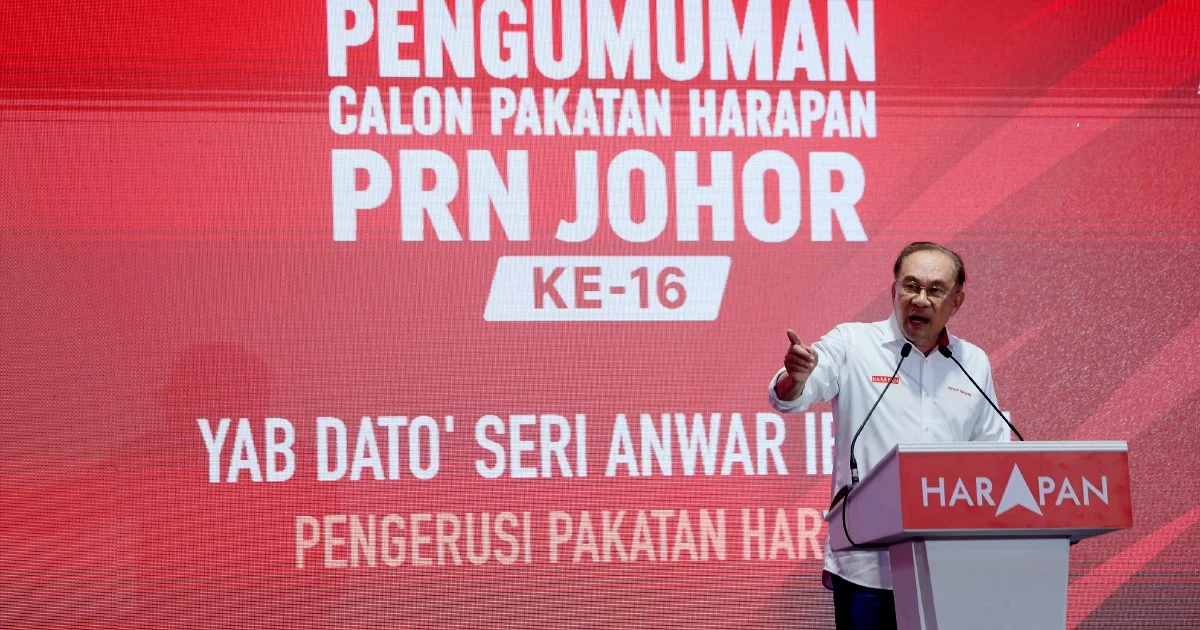
Prime Minister Datuk Seri Anwar Ibrahim has called on Johor's executive councillors to demand transparency and accountability from the country's two previous federal administrations regarding long-standing disputes over the state's share of national revenue. Speaking during a visit to Tangkak, Anwar emphasized the importance of state officials taking a more assertive stance in questioning the Barisan Nasional and Perikatan Nasional governments about revenue distribution practices.
The appeal reflects growing concerns within Johor's state government about the adequacy of federal funding flows to the state, a matter that has periodically surfaced as a contentious issue in federal-state relations. Johor, as the nation's second-largest state by population and a significant economic contributor, has long maintained that its share of federal allocations does not proportionally reflect its economic output or development needs. This grievance has featured in broader discussions about fiscal federalism and the distribution of Malaysia's national revenue among constituent states.
Anwar's intervention signals the federal government's willingness to address historical grievances while simultaneously positioning itself as more responsive to state-level concerns than its predecessors. By encouraging Johor's executive councillors to engage in rigorous questioning rather than passive acceptance, the Prime Minister is effectively endorsing a more combative approach to revenue negotiations. This stance could reshape the dynamics of federal-state fiscal relationships, potentially encouraging other states to similarly advocate for their financial interests more forcefully.
The Barisan Nasional government, which held federal power for six decades before its defeat in 2018, operated under different revenue allocation frameworks across various periods. Similarly, the Perikatan Nasional administration, which governed from 2020 to 2022, implemented its own policies regarding state funding. Both administrations' records on revenue distribution to Johor remain subjects of scrutiny, with state officials arguing that various factors—including population growth, economic development status, and comparative disadvantage—warranted higher allocations than were actually provided.
Johor's financial position carries particular significance for Malaysian politics and economics. The state houses major industrial clusters, substantial port facilities, and significant agricultural operations. Its proximity to Singapore also generates considerable cross-border economic activity and fiscal implications. A state with these characteristics naturally expects revenue distributions that acknowledge its economic contributions to the federation, making revenue allocation disputes substantively different from similar complaints in less economically developed states.
Anwar's directive to state executive councillors implicitly challenges them to conduct comprehensive audits and comparative analyses of previous revenue decisions. Such investigations could reveal patterns of resource allocation that, from Johor's perspective, were unfairly calibrated. Whether such examinations ultimately vindicate state claims or reveal more complex explanatory factors remains to be seen, but the process itself could generate valuable documentation of past practices and establish baselines for future negotiations.
The broader context of federal-state relations in Malaysia involves intricate constitutional provisions, revenue-sharing formulas established under the Federal Constitution, and various agreements developed over decades. These arrangements reflect compromises between centralizing and federalist impulses, and their interpretation has frequently generated controversy. Johor's situation exemplifies the tension between uniform application of established formulas and arguments that exceptional circumstances warrant special treatment or recalibration.
For Johor specifically, pursuing greater clarity on historical revenue decisions could strengthen its negotiating position in current and future budget discussions. Documentation of past shortfalls or unfavourable treatment could provide leverage in arguing for adjusted allocations. Additionally, such scrutiny might reveal systemic issues in how the federal government calculates and distributes state revenues, potentially benefiting not only Johor but other states facing similar concerns.
Anwar's comments also reflect the political imperatives of maintaining coalition stability. Johor, despite its historical association with the Umno-led Barisan Nasional, is crucial to federal government stability under the current administration. Demonstrating responsiveness to state government priorities—including revenue concerns—helps maintain political cohesion and prevents defections that could destabilize the federal coalition. This practical political consideration aligns with the substantive merits of addressing genuine fiscal grievances.
The Tangkak visit and remarks signal that revenue distribution issues will likely feature more prominently in federal-state dialogue under the current administration. Rather than treating such matters as settled through existing formulas, Anwar appears willing to revisit historical decisions and examine whether previous governments adequately served state interests. This approach could either lead to concrete adjustments in funding allocations or simply provide catharsis through investigation and acknowledgment of past grievances.
Moving forward, Johor's executive council will face the challenge of translating Anwar's encouragement into concrete actions. Establishing task forces to examine historical revenue data, comparing Johor's allocations against those received by comparable states, and documenting specific instances where funding was deemed inadequate would constitute logical next steps. Such efforts would provide evidentiary foundations for future negotiations with the federal government.
The implications of this approach extend beyond Johor's immediate interests. If the state successfully leverages historical grievances into improved federal funding, other states may follow suit, potentially requiring the federal government to revisit its entire revenue distribution framework. This could either lead to a more equitable system or generate political complications if adjustments for one state necessitate reductions elsewhere. Balancing these competing pressures will test Anwar's administration's ability to address legitimate state concerns while maintaining overall fiscal stability and intergovernmental harmony.