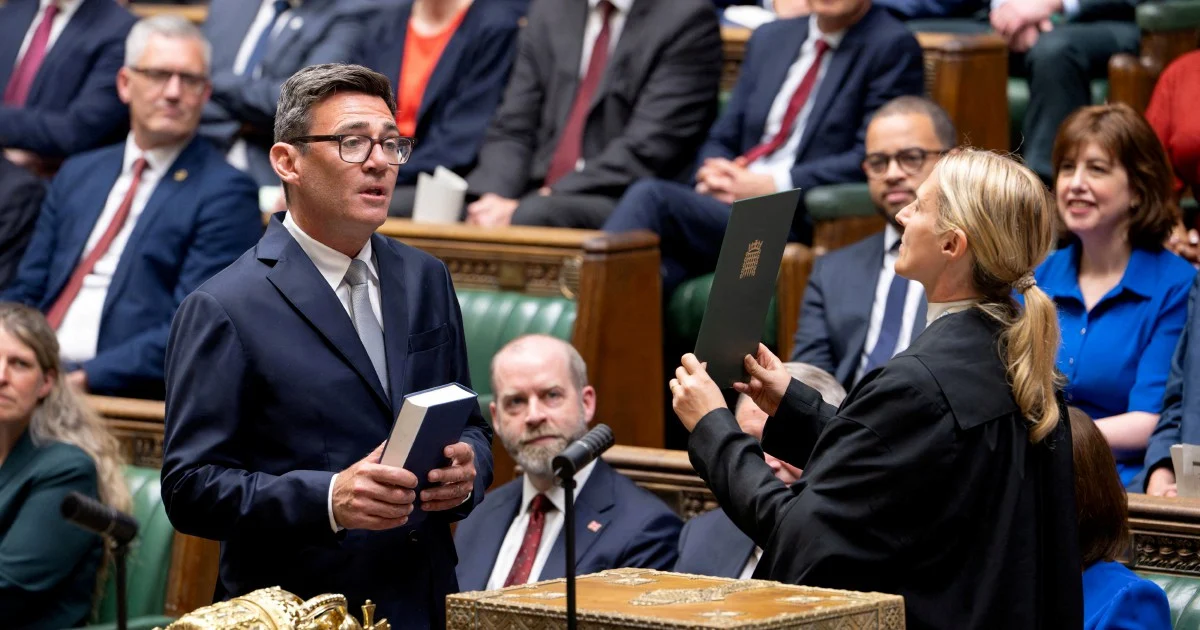
Andy Burnham, the Mayor of Greater Manchester, has rapidly emerged as the leading contender to become Britain's next Labour prime minister following Keir Starmer's announcement that he will step down as party leader. The 56-year-old politician received a celebrated reception in Westminster on Monday as the political establishment began reassessing the future direction of the Labour Party after Starmer's unexpected departure. This moment represents a significant turning point in British politics, with profound implications for how Labour will position itself heading into the next general election and potentially reshape governance across the United Kingdom.
Burnham's rise to prominence reflects a broader shift in Labour's political strategy towards embracing regional leadership and addressing the concerns of constituencies beyond London and the southeast. His tenure as Mayor of Greater Manchester since 2017 has established him as a figure capable of delivering tangible improvements in living standards, transport infrastructure, and economic development in one of England's most economically significant regions. Unlike many Westminster politicians who remain primarily focused on the capital, Burnham has built a reputation for championing the interests of northern England, earning him the informal title of the "King of the North" among supporters and media commentators alike. This geographic authenticity could prove decisive in Labour's attempt to rebuild trust with working-class voters who have drifted away from the party over the past decade.
The Wigan-born politician brings a distinctive narrative to the leadership race, combining working-class origins with extensive parliamentary experience and executive governance credentials. His early career included roles as health secretary and culture secretary in previous Labour governments, providing him with substantive experience in major portfolios. However, it is his more recent work in local government that has defined his modern political identity. As Mayor, he has negotiated significant devolution deals with central government, expanded the Greater Manchester Combined Authority's powers, and positioned the region as a centre for innovation in areas ranging from healthcare to sustainable transport. These accomplishments demonstrate his capacity to deliver measurable results beyond merely articulating a political vision.
Burnham's potential elevation carries substantial significance for Malaysian and Southeast Asian readers interested in understanding shifts within major Commonwealth democracies and their potential economic consequences. Labour Party leadership transitions in the United Kingdom directly influence trade relationships, immigration policies, and broader Asia-Pacific engagement strategies. A prime minister from Manchester would potentially offer fresh perspectives on regional development and devolution that could influence how Britain approaches partnerships with growing economies in Southeast Asia. Furthermore, Labour's direction will shape how the UK positions itself competitively against other major trading blocs, potentially affecting market access and investment flows that impact the wider region.
The circumstances surrounding Starmer's resignation suggest that party members and MPs have grown frustrated with the trajectory and messaging of the current Labour administration. Starmer, who assumed leadership in 2020 and became prime minister after Labour's 2024 general election victory, has faced mounting internal dissent and public criticism regarding policy implementation and political strategy. The desire for fresh leadership reflects deeper anxieties within the party about whether current approaches will sustain Labour's electoral coalition and effectively address the country's multiple challenges. Burnham's emergence as the frontrunner suggests many in the party believe his style of pragmatic regionalism and focus on material improvements in people's lives represents a more persuasive political direction.
Burnham's political philosophy emphasizes pragmatism over ideology, focusing on what works for communities rather than adhering strictly to doctrinal positions. This approach has enabled him to maintain broad support across different wings of the Labour movement during a period of significant internal division. He has successfully navigated tensions between traditional Labour constituencies concerned with industrial heritage and transformation towards modern green industries and technology sectors. His ability to articulate how economic change can benefit northern communities rather than leaving them behind distinguishes him from many metropolitan Labour figures who struggle to connect authentically with these constituencies.
The parliamentary reception accorded to Burnham on Monday, though unofficial in nature, reflected genuine relief and enthusiasm from numerous MPs hopeful that his leadership could rejuvenate Labour's prospects. However, the formal leadership election will involve party members nationwide, not merely Westminster opinion. Burnham's challenge will be to translate his considerable regional popularity and influence into a nationwide campaign message that resonates across Britain's diverse communities. His track record of delivery and communication skills in Greater Manchester provide foundations for this ambition, yet leading a national party and government demands different capacities than managing a regional authority.
International observers will scrutinize how a potential Burnham-led Labour government might reshape British foreign policy, particularly regarding engagement with Asian economies and regional organisations. Burnham's relatively low-profile international positioning compared to some other senior Labour figures could mean either fresh approaches or a period of policy consolidation. His prioritization of domestic concerns, particularly in economically depressed regions, suggests that traditional foreign policy concerns might take secondary importance to ambitious domestic programmes addressing regional inequality and public service improvement. This orientation would represent a significant recalibration from Starmer's approach and could reshape how Britain engages with partners across Southeast Asia.
The broader implications of Burnham's potential ascendancy extend to constitutional questions about how power and resources are distributed across the United Kingdom. As someone deeply committed to devolution and regional empowerment, he may advance further decentralization of authority from Westminster to regional bodies. This agenda could reshape governance structures and potentially influence how other nations organize relationships between central and regional authorities, offering alternative models to more centralized governance systems prevalent in parts of Asia. Such constitutional innovations, while primarily domestic in focus, carry implications for global governance discussions and international comparisons of effective administrative arrangements.
Despite his considerable strengths and apparent support from numerous party quarters, Burnham faces genuine obstacles in consolidating his position as leader-in-waiting. Rival candidates will contest the leadership election, potentially offering different visions of Labour's future. Questions about his experience in certain policy domains, particularly foreign affairs and international relations, may emerge during the campaign. Additionally, some within Labour's more ideologically committed factions may view his pragmatism and regional focus as insufficiently transformative, preferring candidates offering more radical departures from Starmer's centrist positioning.
The timeline for Labour's leadership election remains unclear, with party officials still establishing formal processes for selecting Starmer's successor. Burnham's campaign will need to balance maintaining his strong position as the apparent frontrunner while avoiding overconfidence or complacency. His communication strategy should emphasize concrete achievements in Greater Manchester while articulating a compelling vision for national renewal that addresses concerns far beyond his regional base. The contest will ultimately determine not merely who leads Labour, but which conception of the party's identity and purpose prevails heading forward.